Most kitchen frustrations have nothing to do with how the space looks. They have everything to do with how it works.
You open the cabinet under the sink and spend thirty seconds reaching past bottles to find what you need. The corner cabinet has become a no-man’s land where pans go to disappear. The drawer by the stove won’t close cleanly anymore. And somewhere in the back of an upper cabinet, there are still items from the last time you reorganized, three years ago.
These are storage problems, not style problems. The right cabinet configuration can solve most of them before a single jar or pan is unpacked.
For homeowners exploring San Antonio’s top kitchen cabinet solutions, understanding storage function matters just as much as choosing finishes or door profiles. A cabinet that looks great but works poorly is a problem you’ll deal with every single day. One that works well, even in a modest finish, changes how the kitchen feels to use from morning to night.
This guide walks through the specific storage features that make the biggest difference in real San Antonio kitchens, and how to think about them before you walk into a showroom.
The Real Problem With Your Kitchen Storage
Builder-grade kitchens are designed around cost per square foot, not function per square foot. Standard base cabinets typically ship with one or two fixed shelves and a large open interior. That sounds simple enough, but in practice it means stacking things in front of other things, kneeling on the floor to see what’s in the back, and buying organizer bins to compensate for what the cabinet should have provided from the start.
Older homes in central San Antonio, Southtown, King William, Monte Vista, Olmos Park, often have kitchens designed decades before modern cabinet storage features existed. What worked in a 1950s kitchen with far fewer small appliances and packaged food options simply doesn’t work for a 2026 household.
Even newer suburban builds throughout Stone Oak, Helotes, and Cibolo aren’t immune. Developers routinely install the least expensive cabinet package that still photographs well for listings. The cabinets look fine in photos. They just don’t function particularly well.
The good news: you don’t need a full kitchen gut to fix most storage problems. Choosing the right cabinet features from the start, or upgrading during a planned kitchen remodel, solves the majority of these issues before they become daily habits.
San Antonio’s Top Kitchen Cabinet Solutions for Maximum Storage
When kitchen designers and remodelers talk about the best kitchen cabinet solutions, storage features deserve as much attention as door profiles or finish colors. Here are the upgrades that deliver the most meaningful improvement in day-to-day kitchen function.
Pull-Out Shelves That Work Harder Than Fixed Shelves
A standard base cabinet with fixed shelves wastes roughly a third of its depth. You can see the items in front. You can’t comfortably access items in the back. Pull-out shelves — also called roll-out trays or drawer inserts, extend the full depth of the cabinet and slide out to meet you.
For pots, pans, mixing bowls, and small appliances, pull-out shelves are one of the most impactful upgrades available. They don’t add visual drama, but they fundamentally change how easy the cabinet is to use. In a kitchen with deep base cabinets, a good set of pull-outs eliminates kneeling entirely.
This feature is worth requesting specifically when you shop at a cabinet showroom. Not all cabinet lines include pull-outs as standard. At Cabinet Bazaar’s San Antonio showroom, you can see these features working in real cabinet configurations before committing to a package.
Deep Drawer Banks: The Game-Changer for Daily Access
The most-used storage in any kitchen is a well-designed drawer. Replacing a run of base cabinet doors and fixed shelves with a bank of deep drawers, typically three drawers per base unit, with a shallow top drawer and two deeper bottom drawers, transforms how accessible your kitchen storage actually is.
Pots and pans stored in deep bottom drawers are easier to retrieve than when they’re stacked in a base cabinet. Utensils, dry storage, and small pantry items in mid-depth drawers stay visible and accessible without pulling everything out first. The top drawer handles cutlery, tools, and flat items cleanly.
For San Antonio homeowners replacing a full kitchen, converting at least two or three base cabinet runs to deep drawer banks is one of the more practical investments you can make.
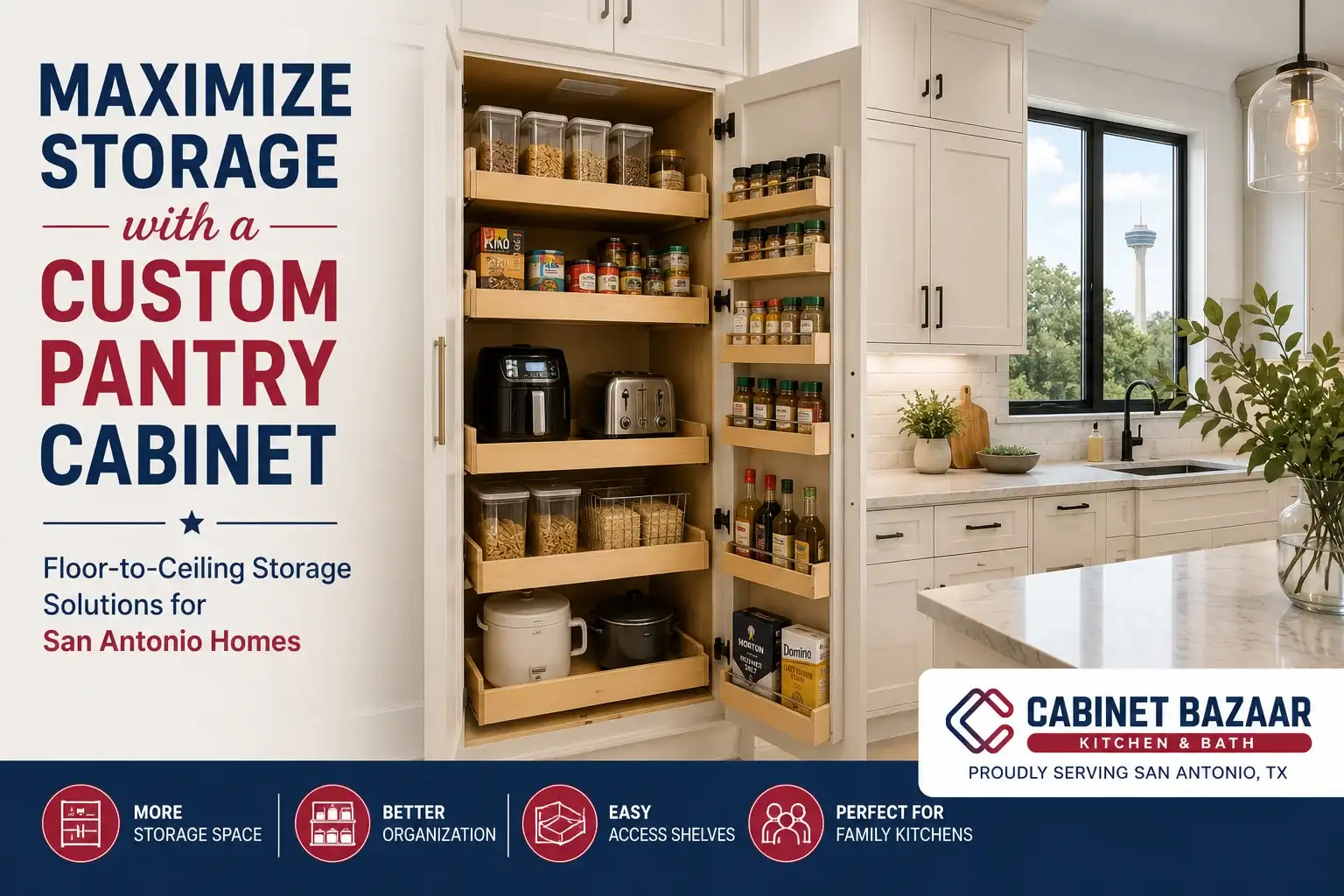
Tall Pantry Cabinets: Adding Storage Without Adding Square Footage
Many San Antonio homes, especially those built in the 1980s and 1990s — were constructed without a dedicated pantry. The kitchen has a standard run of upper and lower cabinets but no dedicated tall storage. A floor-to-ceiling pantry cabinet fills this gap without adding square footage to the house.
A standard tall pantry cabinet runs 84 to 96 inches high and can be configured with fixed shelves, pull-out drawers, or a combination of both. For a family kitchen in San Antonio, where cooking from scratch and buying in bulk are both common, a well-designed pantry cabinet adds a category of storage that many homes simply don’t have.
Browse the full range of base and tall cabinet options at Cabinet Bazaar to see which configurations are available in your preferred style and finish.
Corner Cabinet Solutions That Actually Solve the Corner Problem
Corner cabinets are one of the most consistently frustrating elements in standard kitchen layouts. A traditional corner base cabinet can hold a significant volume of items, but without a good access solution, most of that space goes to waste.
The most practical corner solutions include:
- Lazy Susans: Rotating trays that bring stored items to the front when the door opens. Classic and reliable, though items at the back of each tray can still be hard to access.
- Blind corner pull-outs: A two-part system where one tray slides out and the second swings forward. Significantly better access than a lazy Susan for the same footprint.
- Swing-out shelving systems: Full-depth shelves that pivot outward when the door opens, bringing everything out to where you can reach it. Best access, but at a higher cost.
Which solution is right for your kitchen depends on your corner configuration, budget, and how you use the space. The Cabinet Bazaar design team can walk you through options that fit your specific layout during a showroom visit.
Soft-Close Hardware: The Small Upgrade With Big Daily Impact
Soft-close hinges and drawer slides are standard in quality cabinets, but they’re worth confirming when you evaluate a cabinet line. Doors and drawers with soft-close hardware close quietly without slamming — and that matters more than it sounds over years of daily use. In a busy family kitchen, the reduced impact stress on cabinet boxes adds up quickly.
Storage Configurations by San Antonio Kitchen Type
The right storage configuration depends in part on how your kitchen is laid out and how your household uses the space. Here’s how storage priorities break down across the most common San Antonio kitchen types.
Smaller Kitchens in Central San Antonio Neighborhoods
Kitchens in older neighborhoods like Southtown, Alamo Heights, and Terrell Hills tend to be compact — storage needs to be precise, with no room for wasted space. Full-depth pull-out shelves in every base cabinet maximize access in a smaller footprint. A tall pantry unit adds storage volume without expanding the kitchen’s layout. Upper cabinets extended to ceiling height where clearance allows, and drawer banks instead of base cabinet doors wherever the run permits, round out the approach.
The design service at Cabinet Bazaar includes 3D layout planning, which is particularly useful for smaller kitchens where every inch of storage placement matters.
Open-Concept Kitchens in Stone Oak and Helotes
Open-concept kitchens in newer communities throughout Stone Oak, Helotes, and Fair Oaks Ranch face a different challenge: storage must be organized and kept neat, because the kitchen is visible from the living area. Consistent, organized base cabinet storage with deep drawers for the most-used items, a dedicated tall pantry or built-in cabinet to keep dry goods and small appliances behind closed doors, and integrated features like built-in trash pull-outs and spice pull-outs near the range keep countertops clear and the kitchen looking sharp from across the room.
Large Family Kitchens in Suburban San Antonio
Family kitchens in communities like Schertz, Cibolo, and New Braunfels tend to be larger but face high-volume demands. Multiple people, frequent cooking, and large grocery hauls require storage that can hold everything without constant reorganization. At least two base cabinet runs converted to deep drawer banks, a large pantry cabinet with adjustable shelving, corner solutions that actually work — blind corner pull-outs or swing-out systems rather than standard lazy Susans — and upper cabinets at maximum height for volume storage are the priorities here.
What Every San Antonio Homeowner Should Know About Kitchen Storage
Here are direct answers to the questions homeowners ask most often when planning a kitchen remodel in San Antonio.
What’s the single most impactful storage upgrade?
Pull-out shelves in base cabinets. Applied consistently across all base cabinets, this one change eliminates the most common kitchen storage frustration — reaching blindly into the back of a cabinet, without major cost.
What cabinet configuration works best for a family of four or more?
Deep drawer banks for frequently used items, pull-out base shelves for bulk storage, a tall pantry unit for dry goods, and upper cabinets for overflow and display. This covers the storage categories most large households actually need.
Built-in features vs. aftermarket organizers?
Built-in features — pull-outs, drawer banks, soft-close hardware — are preferable because they’re designed to fit the cabinet precisely. Aftermarket organizers can supplement specific drawers or shelves, but they’re not a substitute for purpose-built storage.
Does a pull-out trash cabinet make sense?
Yes, for most households. It removes bins from the floor or countertop and tucks them out of sight but within arm’s reach. Consistently one of the most appreciated features after a kitchen remodel.
Best corner cabinet solution for small kitchens?
A blind corner pull-out provides the best balance of access and cost. Swing-out systems offer better access but take more space when open. Lazy Susans are the most affordable but require more reaching.
Choosing Cabinet Hardware That Supports Better Organization
Hardware matters for storage function as well as appearance. Bar pulls on lower cabinets and drawer fronts are easier to grip than knobs — particularly when your hands are wet or greasy from cooking — and they provide a more positive grip when pulling open heavy drawers loaded with pots and pans.
For upper cabinets, knobs work well on smaller doors. For larger upper cabinets with double doors, bar pulls or cup pulls offer better leverage. And soft-close hardware is worth specifying on everything — once you’ve used a kitchen with properly functioning soft-close drawers and hinges, standard hardware feels noticeably worse.
Explore the full knobs and handles collection at Cabinet Bazaar to find hardware that matches your cabinet style and finish.
Kitchen Cabinet Storage Features at a Glance
| Feature | Best For | Impact Level | Typical Cost |
|---|---|---|---|
| Pull-Out Shelves | Base cabinets with pots, pans, bulk items | Very High | Low to Moderate |
| Deep Drawer Banks | Daily-use items, cookware, utensils | Very High | Moderate |
| Tall Pantry Cabinet | Households without a separate pantry | High | Moderate |
| Blind Corner Pull-Out | Corner base cabinets | High | Moderate |
| Lazy Susan | Budget corner solutions | Medium | Low |
| Soft-Close Hardware | All doors and drawers | High | Low |
| Built-In Trash Pull-Out | Under-sink or dedicated base cabinet | High | Low to Moderate |
Frequently Asked Questions About Kitchen Cabinet Storage in San Antonio
Are pull-out shelves available in all cabinet lines at Cabinet Bazaar?
Pull-out shelves are available across most cabinet configurations, though availability varies by line and door style. Ask specifically during your showroom visit — the team can show you which configurations include pull-outs as standard and where they’re available as upgrades.
How do I know how many drawers vs. doors I need in my kitchen?
Start by replacing base cabinets near your primary work area — beside the range, near the sink, adjacent to the refrigerator — with drawer banks. Base cabinets used for bulk storage, under the sink, or for items accessed less frequently can remain as door-and-shelf configurations. This balances cost and function well for most kitchens.
Can I add pull-out shelves to existing cabinets?
Yes. Aftermarket pull-out shelf inserts can be fitted into most standard base cabinets. They’re not as precise a fit as built-in options, but they’re a practical solution for homeowners who aren’t replacing cabinets. The Cabinet Bazaar team can advise on which option makes more sense for your situation.
What is the most common storage mistake San Antonio homeowners make during a kitchen remodel?
Focusing entirely on appearance — choosing a cabinet style and finish — without thinking through the storage configuration. Homeowners often choose the same base cabinet setup they currently have simply because it’s familiar. Taking time to think through how each cabinet will actually be used leads to a kitchen that functions significantly better day-to-day.
Does Cabinet Bazaar offer 3D kitchen design in San Antonio?
Yes. Cabinet Bazaar provides a professional 3D kitchen and bathroom design service that lets you plan your storage layout, cabinet configuration, and finishes before any purchase is made. You can also use the online 3D cabinet model tool to start exploring options from home.
Do storage features like pull-outs and drawer banks add resale value to a San Antonio home?
Functional kitchen upgrades — including well-organized storage — are consistently cited by buyers and real estate professionals as key factors in kitchen appeal. Kitchen remodels show strong return on investment in the San Antonio real estate market. Buyers notice a kitchen that works well when they tour a home.
Ready to Redesign Your Kitchen Storage?
Good storage isn’t an afterthought. It’s one of the core reasons a kitchen works well — or frustrates you every day.
San Antonio’s top kitchen cabinet solutions include far more than a new door profile and a fresh coat of paint. They include pull-out shelves that reach the back of every base cabinet. Drawer banks that put everyday items right at your fingertips. Pantry cabinets that consolidate your dry storage into one organized place. Corner solutions that recover space most kitchens simply waste.
Cabinet Bazaar’s San Antonio showroom, located at 5601 Bandera Rd, Suite 100, San Antonio, TX 78238, gives you the chance to see these features working in real cabinet configurations — not just described on a spec sheet. The team works with homeowners across San Antonio, Stone Oak, Alamo Heights, Helotes, Boerne, Schertz, and Cibolo to plan kitchens that function as well as they look.
Visit cabinetbazaar.com or call 1 (210) 773 2799 to schedule a free kitchen design consultation. Bring your measurements, your photos, and your wish list, and build a kitchen that actually works for your household.