Table of Contents
- The Real Cost of Getting Countertop Installation Wrong
- What the Installation Process Actually Looks Like
- Why the Fabricator You Choose Changes Everything
- Granite Countertop Installation in San Antonio
- Quartz Countertop Installation in San Antonio
- Custom Countertop Edges, Cutouts, and Finishes
- How to Prepare Your Kitchen Before Installation Day
- What to Ask Before You Hire a Countertop Company in San Antonio
- Cabinet Bazaar: San Antonio’s Local Countertop Source
- FAQs About Countertop Installation in San Antonio
The Real Cost of Getting Countertop Installation Wrong
Kitchen countertops aren’t cheap. Even at entry-level granite pricing, a full kitchen replacement in San Antonio runs several thousand dollars once material and installation are factored in. At the high end, you’re looking at $6,000–$10,000 or more for premium stone in a larger kitchen.
That kind of investment deserves to be handled right. And yet a surprising number of homeowners focus entirely on material selection and treat the installer as an afterthought. That’s where things go sideways.
A countertop installed by someone who doesn’t know what they’re doing will show it — in seams that don’t align, edges that aren’t level, cutouts that leave visible gaps around the sink, and stone that wasn’t properly supported and eventually cracks. None of those problems are cheap to fix after the fact.
Understanding the process, knowing what to ask, and choosing the right local installer is how you protect that investment.
What the Installation Process Actually Looks Like
If you’ve never had countertops replaced before, the process can feel opaque. Here’s what professional countertop installation in San Antonio looks like from start to finish.
Step 1: Measure and Template
After you select your material, a fabricator sends a technician to your kitchen to take precise measurements. This is called templating, and it’s one of the most important steps in the whole process.
Older homes in San Antonio often have walls that aren’t perfectly square and base cabinets that aren’t perfectly level. An experienced templating technician accounts for all of this. The template is used to cut the stone slab to fit your exact kitchen — not a generic approximation of it.
Some companies use digital laser templating, which produces more accurate measurements and reduces human error. It’s worth asking whether your installer uses this technology.
Step 2: Slab Selection
For natural stone — granite, quartzite, marble — slab selection deserves your full attention. Showroom samples only show you a small section of the stone. The full slab can look quite different, and color and veining variation from one slab to another in the same grade can be dramatic.
If possible, visit the yard or warehouse and select the actual slabs that will be cut for your kitchen. What you see in person is what you get.
Step 3: Fabrication
Once the template and slab are confirmed, the fabricator cuts, edges, and polishes the stone. This is where craftsmanship separates average work from exceptional work.
Edge profiles are shaped at this stage — straight eased edges, beveled, ogee, waterfall, bullnose, or custom profiles. Sink cutouts are also cut during fabrication. The quality of these cuts is permanently visible in the finished product.
Step 4: Installation Day
Installation typically takes one day for most kitchens. The existing countertops are removed first. The new stone is set on the base cabinets using adhesive, and seams — where two pieces of stone meet — are joined and polished to be as invisible as possible.
Undermount sinks are secured to the stone from below. The countertop is then caulked where it meets the backsplash wall.
Step 5: Cleanup and Final Inspection
A professional crew leaves the kitchen clean and does a final walk-through with you. This is your chance to inspect seam placement, edge quality, and cutout fit before they leave. Raise concerns on the day — not after the crew is gone.
Why the Fabricator You Choose Changes Everything
In the countertop industry, the same material can produce very different results depending on who cuts and installs it.
In-house fabrication is a real advantage. When a company fabricates their own stone — rather than outsourcing cutting and finishing to a third party — they control quality at every stage. They know exactly how each slab was handled, how the edges were profiled, and how seams were planned.
Companies that outsource fabrication often have less visibility into problems until the stone shows up at your house. That’s not where you want to discover an issue.
Local experience matters too. A San Antonio fabricator who has been working in this market for years knows the specific challenges of local homes: older cabinetry, the effects of heat and humidity on stone, and the construction styles that come with the territory.
Granite Countertop Installation in San Antonio
Granite is consistently one of the most requested materials at local countertop shops in San Antonio — and with good reason. It’s beautiful, holds up to real cooking use, and adds demonstrable value to a home.
Planning Seams Before the Cut
On larger kitchens, seams are unavoidable. A skilled fabricator plans seam placement so they fall in less visible locations — near a sink or appliance rather than in an open expanse of counter. Less experienced installers don’t always think this through, and you end up with a visible seam in the worst possible spot.
Weight and Cabinet Load
Granite is heavy. Standard 3/4-inch granite runs around 13 pounds per square foot. A 40-square-foot kitchen weighs over 500 pounds. Base cabinets need to be sound, and the installation team needs experience handling large stone pieces without cracking them during the move.
Sealing After Installation
A professional installer should apply a sealer after installation. This is standard practice, not an optional add-on. Ask whether sealing is included before you sign anything.
Quartz Countertop Installation in San Antonio
Engineered quartz installation follows a similar process to granite, with a few differences worth knowing.
Consistency and Seam Matching
Because quartz is manufactured to consistent specifications, slabs have less variation than natural stone. Seam matching is easier and more predictable. The non-porous surface doesn’t require sealing, which eliminates one post-installation step.
Heat Sensitivity: What to Know Before You Install
The trade-off with quartz is heat sensitivity. It contains polymer resins that can discolor or warp with prolonged heat exposure. A professional installer should advise you on this and make sure you have trivets or heat pads for areas where hot cookware will land.

Brands matter more with quartz than with natural stone. Silestone, Caesarstone, Cambria, and MSI all produce quality products with solid warranties. Cheaper off-brand quartz carries more variability in manufacturing quality. A local San Antonio countertop supplier who carries name-brand quartz is a safer bet than a discount online-only vendor.
Custom Countertop Edges, Cutouts, and Finishes
The details are where a countertop installation goes from ordinary to exceptional. Most homeowners focus on material and color — and leave edge profiles, cutout quality, and finish options as afterthoughts. That’s backwards.
Edge Profile Options
Edge profiles affect both the look and the perceived quality of the finished countertop. The most common options:
- Eased edge — simple, modern, clean. Works in almost any kitchen style.
- Beveled — a slight angle on the top edge. Similar to eased but with a more defined look.
- Bullnose — fully rounded edge. A classic look that’s been popular for decades.
- Ogee — an S-curve profile. Traditional, ornate, best suited for formal kitchen styles.
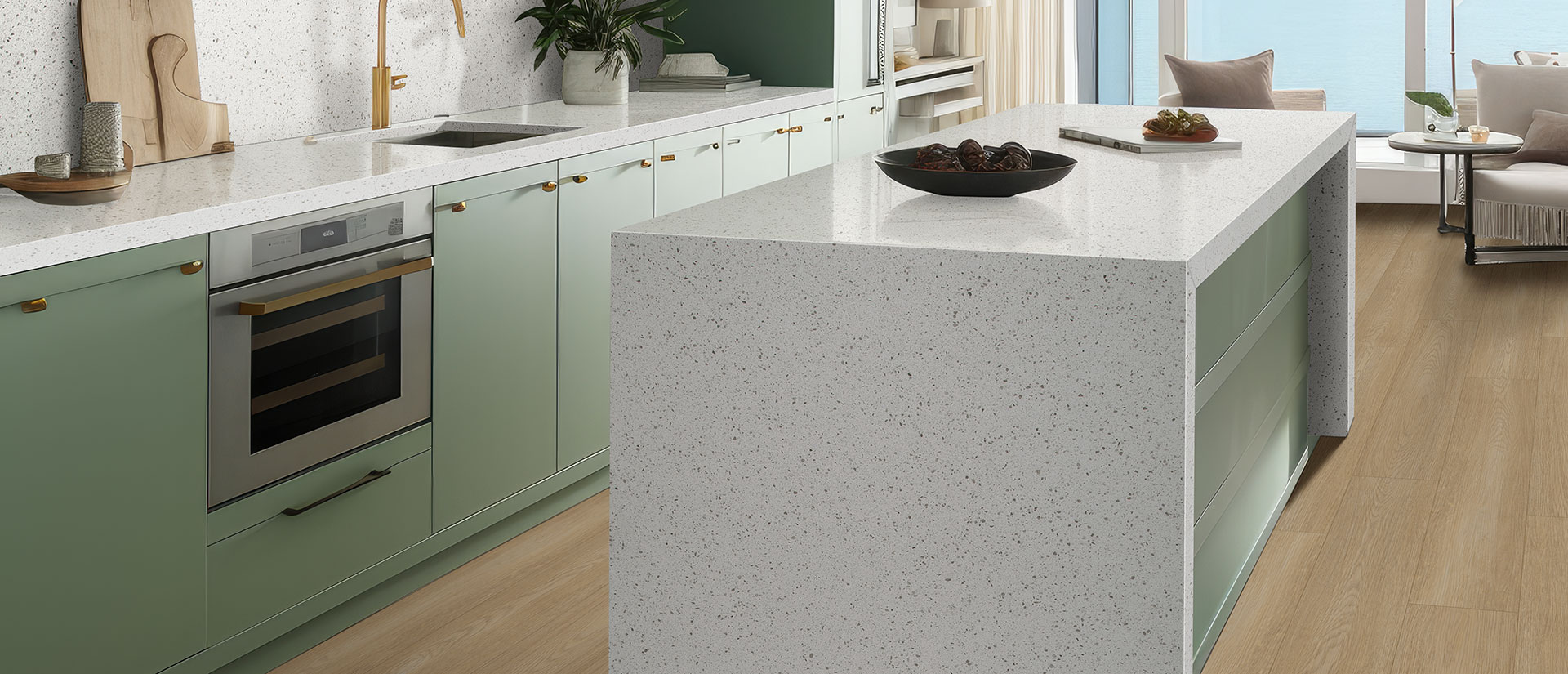
- Waterfall — the stone extends vertically down the cabinet side to the floor. Works best on islands visible from multiple angles.
Sink and Cooktop Cutouts
Sink cutouts need to match the exact dimensions of your sink. An undermount sink has to be secured precisely to the stone, with a clean opening and smooth polished edge. It’s more technically demanding than a drop-in cutout and requires a fabricator with real experience. Cooktop cutouts follow the same principle — the opening has to match the appliance dimensions exactly.
Stone Backsplash from the Same Slab
Backsplash is sometimes cut from the same stone slab as the countertop, creating a continuous look from counter to wall. This is a nice upgrade where budget allows, and worth discussing with your San Antonio fabricator during the design phase.
How to Prepare Your Kitchen Before Installation Day
A few steps make installation day go more smoothly and help the crew work efficiently:
Clear the countertops completely. Everything — appliances, cookware, dishes, utensils — needs to come off before the crew arrives.
Empty the cabinets directly below the countertops. Vibration from the removal process can shift items inside.
Handle the plumbing question in advance. Some countertop installers handle disconnection and reconnection of undermount sinks; others require a licensed plumber. Clarify this before installation day so there are no surprises.
Plan for a partial kitchen outage. Silicone caulk and adhesives need 24–48 hours to cure before the sink can be used at full pressure. Plan your meals accordingly.
What to Ask Before You Hire a Countertop Company in San Antonio
Before committing to any countertop company in San Antonio, get clear answers to these questions:
Do you fabricate in-house or outsource? In-house fabrication gives you better quality control and direct accountability.
Can I see the actual slabs before they’re cut? For natural stone, this should always be an option.
What’s included in the installation quote? Confirm that templating, fabrication, installation, sealing (for natural stone), sink cutout, and removal of the old countertop are included — or get clear line items for what isn’t.
What warranty do you offer on installation? A credible installer stands behind their work. Ask specifically what happens if a seam fails or a cutout chips within the first year.
How long have you been operating in San Antonio? Local experience matters. A company that has been in the San Antonio market for years has a track record you can actually check.
Can you provide recent local references or reviews? Look at Google reviews specifically — they’re harder to manipulate than testimonials on a company’s own website.
Cabinet Bazaar: San Antonio’s Local Countertop Source
Cabinet Bazaar is a San Antonio-based kitchen and countertop company offering granite, quartz, stone, and custom countertop solutions for homeowners across the city and surrounding areas.
Working with a local operation like Cabinet Bazaar means you’re dealing with people who are based here, know the San Antonio market, and have a direct stake in the quality of their work. No national call center, no regional rep who’s never seen your neighborhood. You deal with the same team from quote through installation.
In-house fabrication means your countertops are cut and finished locally — not shipped from a regional distribution center. You can see the slab, approve the layout, and know exactly what’s being installed before work begins.
Without the overhead of a national retail chain, Cabinet Bazaar prices premium materials competitively. For equivalent material grades, local suppliers typically beat big-box pricing, particularly on fabrication and installation.
Whether you’re doing a full kitchen remodel or replacing just the countertops, Cabinet Bazaar serves homeowners throughout San Antonio and surrounding communities across Bexar County.
FAQs About Countertop Installation in San Antonio
How long does countertop installation take?
The installation itself typically takes one day for a standard kitchen. The full timeline from initial measurement to completed installation is usually one to three weeks, depending on material availability and fabrication schedule.
Do I need to remove my old countertops before installation?
No. Removal of existing countertops is typically part of the installation service. Confirm this is included in your quote.
What’s the lead time for granite vs. quartz in San Antonio?
Both are generally available within one to two weeks. Specialty slabs or high-demand patterns may take longer if they need to be sourced from a specific supplier.
Can countertops be installed over existing tile?
In most cases, existing tile countertops should be removed before new stone is installed. The uneven surface creates problems for proper stone support and seam alignment.
How soon after installation can I use my kitchen?
Most adhesives and caulk cure within 24 hours. You can use the counter surface right away, but wait 24–48 hours before using the sink with full water pressure.
Does Cabinet Bazaar offer free quotes for kitchen countertops in San Antonio?
Yes. Cabinet Bazaar provides free in-home or showroom consultations and quotes for kitchen countertop installation throughout San Antonio and the greater area.
What areas around San Antonio does Cabinet Bazaar serve?
Cabinet Bazaar serves homeowners throughout the San Antonio metro area, including surrounding communities across Bexar County.
Looking for kitchen countertops in San Antonio from a team that handles everything from slab selection through installation? Contact Cabinet Bazaar for a free quote and see our current stone selection in person.