How San Antonio’s Top Kitchen Cabinet Solutions Can Transform Your Kitchen Storage

Most kitchen frustrations have nothing to do with how the space looks. They have everything to do with how it works.

You open the cabinet under the sink and spend thirty seconds reaching past bottles to find what you need. The corner cabinet has become a no-man’s land where pans go to disappear. The drawer by the stove won’t close cleanly anymore. And somewhere in the back of an upper cabinet, there are still items from the last time you reorganized, three years ago.

These are storage problems, not style problems. The right cabinet configuration can solve most of them before a single jar or pan is unpacked.

For homeowners exploring San Antonio’s top kitchen cabinet solutions, understanding storage function matters just as much as choosing finishes or door profiles. A cabinet that looks great but works poorly is a problem you’ll deal with every single day. One that works well, even in a modest finish, changes how the kitchen feels to use from morning to night.

This guide walks through the specific storage features that make the biggest difference in real San Antonio kitchens, and how to think about them before you walk into a showroom.

The Real Problem With Your Kitchen Storage

Builder-grade kitchens are designed around cost per square foot, not function per square foot. Standard base cabinets typically ship with one or two fixed shelves and a large open interior. That sounds simple enough, but in practice it means stacking things in front of other things, kneeling on the floor to see what’s in the back, and buying organizer bins to compensate for what the cabinet should have provided from the start.

Older homes in central San Antonio, Southtown, King William, Monte Vista, Olmos Park, often have kitchens designed decades before modern cabinet storage features existed. What worked in a 1950s kitchen with far fewer small appliances and packaged food options simply doesn’t work for a 2026 household.

Even newer suburban builds throughout Stone Oak, Helotes, and Cibolo aren’t immune. Developers routinely install the least expensive cabinet package that still photographs well for listings. The cabinets look fine in photos. They just don’t function particularly well.

The good news: you don’t need a full kitchen gut to fix most storage problems. Choosing the right cabinet features from the start, or upgrading during a planned kitchen remodel, solves the majority of these issues before they become daily habits.

San Antonio’s Top Kitchen Cabinet Solutions for Maximum Storage

When kitchen designers and remodelers talk about the best kitchen cabinet solutions, storage features deserve as much attention as door profiles or finish colors. Here are the upgrades that deliver the most meaningful improvement in day-to-day kitchen function.

Pull-Out Shelves That Work Harder Than Fixed Shelves

A standard base cabinet with fixed shelves wastes roughly a third of its depth. You can see the items in front. You can’t comfortably access items in the back. Pull-out shelves — also called roll-out trays or drawer inserts, extend the full depth of the cabinet and slide out to meet you.

For pots, pans, mixing bowls, and small appliances, pull-out shelves are one of the most impactful upgrades available. They don’t add visual drama, but they fundamentally change how easy the cabinet is to use. In a kitchen with deep base cabinets, a good set of pull-outs eliminates kneeling entirely.

This feature is worth requesting specifically when you shop at a cabinet showroom. Not all cabinet lines include pull-outs as standard. At Cabinet Bazaar’s San Antonio showroom, you can see these features working in real cabinet configurations before committing to a package.

Deep Drawer Banks: The Game-Changer for Daily Access

The most-used storage in any kitchen is a well-designed drawer. Replacing a run of base cabinet doors and fixed shelves with a bank of deep drawers, typically three drawers per base unit, with a shallow top drawer and two deeper bottom drawers, transforms how accessible your kitchen storage actually is.

Pots and pans stored in deep bottom drawers are easier to retrieve than when they’re stacked in a base cabinet. Utensils, dry storage, and small pantry items in mid-depth drawers stay visible and accessible without pulling everything out first. The top drawer handles cutlery, tools, and flat items cleanly.

For San Antonio homeowners replacing a full kitchen, converting at least two or three base cabinet runs to deep drawer banks is one of the more practical investments you can make.

Tall Pantry Cabinets: Adding Storage Without Adding Square Footage

Many San Antonio homes, especially those built in the 1980s and 1990s — were constructed without a dedicated pantry. The kitchen has a standard run of upper and lower cabinets but no dedicated tall storage. A floor-to-ceiling pantry cabinet fills this gap without adding square footage to the house.

A standard tall pantry cabinet runs 84 to 96 inches high and can be configured with fixed shelves, pull-out drawers, or a combination of both. For a family kitchen in San Antonio, where cooking from scratch and buying in bulk are both common, a well-designed pantry cabinet adds a category of storage that many homes simply don’t have.

Browse the full range of base and tall cabinet options at Cabinet Bazaar to see which configurations are available in your preferred style and finish.

Corner Cabinet Solutions That Actually Solve the Corner Problem

Corner cabinets are one of the most consistently frustrating elements in standard kitchen layouts. A traditional corner base cabinet can hold a significant volume of items, but without a good access solution, most of that space goes to waste.

The most practical corner solutions include:

  • Lazy Susans: Rotating trays that bring stored items to the front when the door opens. Classic and reliable, though items at the back of each tray can still be hard to access.
  • Blind corner pull-outs: A two-part system where one tray slides out and the second swings forward. Significantly better access than a lazy Susan for the same footprint.
  • Swing-out shelving systems: Full-depth shelves that pivot outward when the door opens, bringing everything out to where you can reach it. Best access, but at a higher cost.

Which solution is right for your kitchen depends on your corner configuration, budget, and how you use the space. The Cabinet Bazaar design team can walk you through options that fit your specific layout during a showroom visit.

Soft-Close Hardware: The Small Upgrade With Big Daily Impact

Soft-close hinges and drawer slides are standard in quality cabinets, but they’re worth confirming when you evaluate a cabinet line. Doors and drawers with soft-close hardware close quietly without slamming — and that matters more than it sounds over years of daily use. In a busy family kitchen, the reduced impact stress on cabinet boxes adds up quickly.
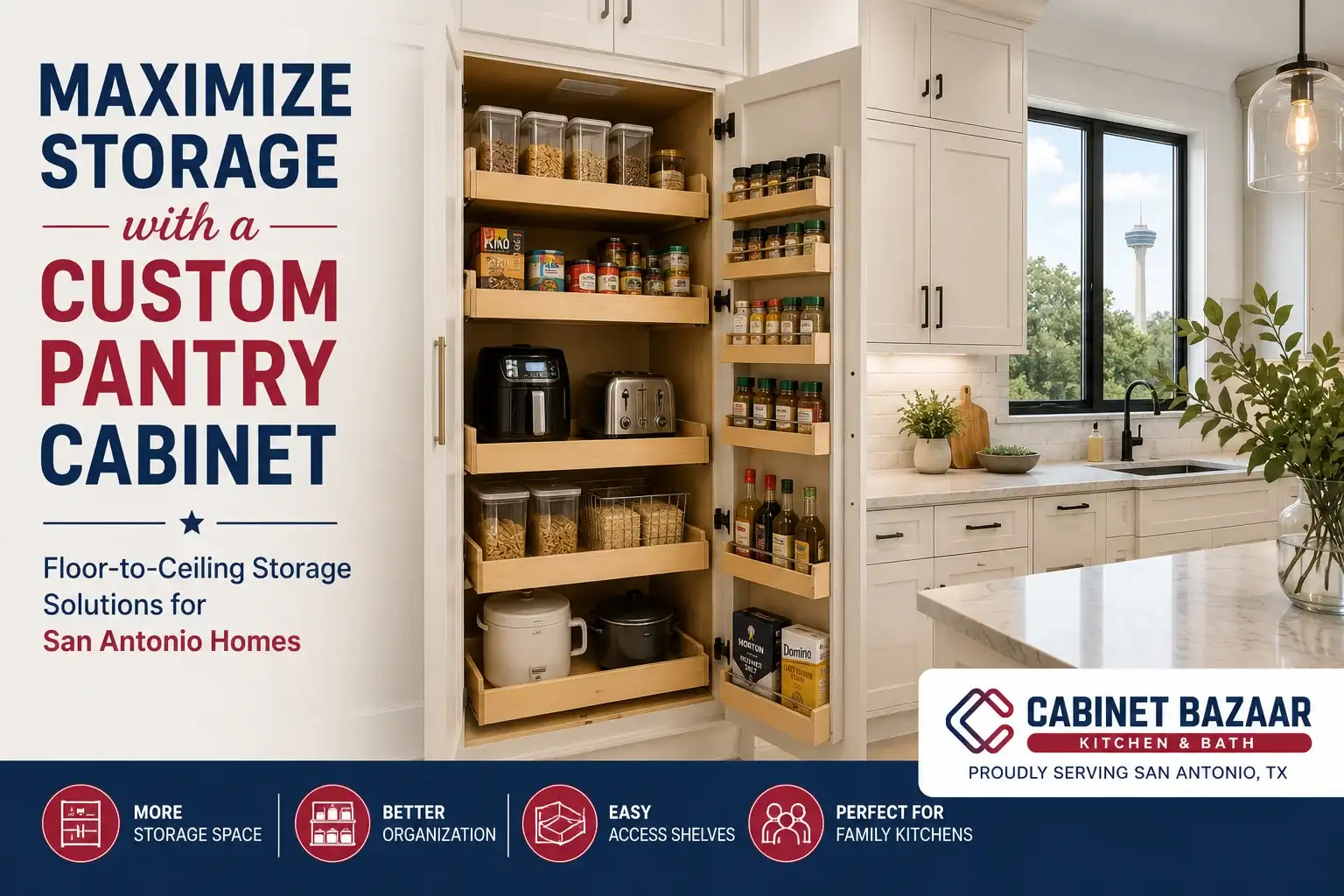
Floor-to-ceiling pantry cabinet installed in a San Antonio kitchen featuring pull-out shelves, organized storage, and custom cabinetry by Cabinet Bazaar
Custom floor-to-ceiling pantry cabinet designed to maximize kitchen storage, organization, and accessibility for San Antonio families.

Storage Configurations by San Antonio Kitchen Type

The right storage configuration depends in part on how your kitchen is laid out and how your household uses the space. Here’s how storage priorities break down across the most common San Antonio kitchen types.

Smaller Kitchens in Central San Antonio Neighborhoods

Kitchens in older neighborhoods like Southtown, Alamo Heights, and Terrell Hills tend to be compact — storage needs to be precise, with no room for wasted space. Full-depth pull-out shelves in every base cabinet maximize access in a smaller footprint. A tall pantry unit adds storage volume without expanding the kitchen’s layout. Upper cabinets extended to ceiling height where clearance allows, and drawer banks instead of base cabinet doors wherever the run permits, round out the approach.

The design service at Cabinet Bazaar includes 3D layout planning, which is particularly useful for smaller kitchens where every inch of storage placement matters.

Open-Concept Kitchens in Stone Oak and Helotes

Open-concept kitchens in newer communities throughout Stone Oak, Helotes, and Fair Oaks Ranch face a different challenge: storage must be organized and kept neat, because the kitchen is visible from the living area. Consistent, organized base cabinet storage with deep drawers for the most-used items, a dedicated tall pantry or built-in cabinet to keep dry goods and small appliances behind closed doors, and integrated features like built-in trash pull-outs and spice pull-outs near the range keep countertops clear and the kitchen looking sharp from across the room.

Large Family Kitchens in Suburban San Antonio

Family kitchens in communities like Schertz, Cibolo, and New Braunfels tend to be larger but face high-volume demands. Multiple people, frequent cooking, and large grocery hauls require storage that can hold everything without constant reorganization. At least two base cabinet runs converted to deep drawer banks, a large pantry cabinet with adjustable shelving, corner solutions that actually work — blind corner pull-outs or swing-out systems rather than standard lazy Susans — and upper cabinets at maximum height for volume storage are the priorities here.

What Every San Antonio Homeowner Should Know About Kitchen Storage

Here are direct answers to the questions homeowners ask most often when planning a kitchen remodel in San Antonio.

What’s the single most impactful storage upgrade?
Pull-out shelves in base cabinets. Applied consistently across all base cabinets, this one change eliminates the most common kitchen storage frustration — reaching blindly into the back of a cabinet, without major cost.

What cabinet configuration works best for a family of four or more?
Deep drawer banks for frequently used items, pull-out base shelves for bulk storage, a tall pantry unit for dry goods, and upper cabinets for overflow and display. This covers the storage categories most large households actually need.

Built-in features vs. aftermarket organizers?
Built-in features — pull-outs, drawer banks, soft-close hardware — are preferable because they’re designed to fit the cabinet precisely. Aftermarket organizers can supplement specific drawers or shelves, but they’re not a substitute for purpose-built storage.

Does a pull-out trash cabinet make sense?
Yes, for most households. It removes bins from the floor or countertop and tucks them out of sight but within arm’s reach. Consistently one of the most appreciated features after a kitchen remodel.

Best corner cabinet solution for small kitchens?
A blind corner pull-out provides the best balance of access and cost. Swing-out systems offer better access but take more space when open. Lazy Susans are the most affordable but require more reaching.

Choosing Cabinet Hardware That Supports Better Organization

Hardware matters for storage function as well as appearance. Bar pulls on lower cabinets and drawer fronts are easier to grip than knobs — particularly when your hands are wet or greasy from cooking — and they provide a more positive grip when pulling open heavy drawers loaded with pots and pans.

For upper cabinets, knobs work well on smaller doors. For larger upper cabinets with double doors, bar pulls or cup pulls offer better leverage. And soft-close hardware is worth specifying on everything — once you’ve used a kitchen with properly functioning soft-close drawers and hinges, standard hardware feels noticeably worse.

Explore the full knobs and handles collection at Cabinet Bazaar to find hardware that matches your cabinet style and finish.

Kitchen Cabinet Storage Features at a Glance

Feature Best For Impact Level Typical Cost
Pull-Out Shelves Base cabinets with pots, pans, bulk items Very High Low to Moderate
Deep Drawer Banks Daily-use items, cookware, utensils Very High Moderate
Tall Pantry Cabinet Households without a separate pantry High Moderate
Blind Corner Pull-Out Corner base cabinets High Moderate
Lazy Susan Budget corner solutions Medium Low
Soft-Close Hardware All doors and drawers High Low
Built-In Trash Pull-Out Under-sink or dedicated base cabinet High Low to Moderate

Frequently Asked Questions About Kitchen Cabinet Storage in San Antonio

Are pull-out shelves available in all cabinet lines at Cabinet Bazaar?

Pull-out shelves are available across most cabinet configurations, though availability varies by line and door style. Ask specifically during your showroom visit — the team can show you which configurations include pull-outs as standard and where they’re available as upgrades.

How do I know how many drawers vs. doors I need in my kitchen?

Start by replacing base cabinets near your primary work area — beside the range, near the sink, adjacent to the refrigerator — with drawer banks. Base cabinets used for bulk storage, under the sink, or for items accessed less frequently can remain as door-and-shelf configurations. This balances cost and function well for most kitchens.

Can I add pull-out shelves to existing cabinets?

Yes. Aftermarket pull-out shelf inserts can be fitted into most standard base cabinets. They’re not as precise a fit as built-in options, but they’re a practical solution for homeowners who aren’t replacing cabinets. The Cabinet Bazaar team can advise on which option makes more sense for your situation.

What is the most common storage mistake San Antonio homeowners make during a kitchen remodel?

Focusing entirely on appearance — choosing a cabinet style and finish — without thinking through the storage configuration. Homeowners often choose the same base cabinet setup they currently have simply because it’s familiar. Taking time to think through how each cabinet will actually be used leads to a kitchen that functions significantly better day-to-day.

Does Cabinet Bazaar offer 3D kitchen design in San Antonio?

Yes. Cabinet Bazaar provides a professional 3D kitchen and bathroom design service that lets you plan your storage layout, cabinet configuration, and finishes before any purchase is made. You can also use the online 3D cabinet model tool to start exploring options from home.

Do storage features like pull-outs and drawer banks add resale value to a San Antonio home?

Functional kitchen upgrades — including well-organized storage — are consistently cited by buyers and real estate professionals as key factors in kitchen appeal. Kitchen remodels show strong return on investment in the San Antonio real estate market. Buyers notice a kitchen that works well when they tour a home.

Ready to Redesign Your Kitchen Storage?

Good storage isn’t an afterthought. It’s one of the core reasons a kitchen works well — or frustrates you every day.

San Antonio’s top kitchen cabinet solutions include far more than a new door profile and a fresh coat of paint. They include pull-out shelves that reach the back of every base cabinet. Drawer banks that put everyday items right at your fingertips. Pantry cabinets that consolidate your dry storage into one organized place. Corner solutions that recover space most kitchens simply waste.

Cabinet Bazaar’s San Antonio showroom, located at 5601 Bandera Rd, Suite 100, San Antonio, TX 78238, gives you the chance to see these features working in real cabinet configurations — not just described on a spec sheet. The team works with homeowners across San Antonio, Stone Oak, Alamo Heights, Helotes, Boerne, Schertz, and Cibolo to plan kitchens that function as well as they look.

Visit cabinetbazaar.com or call 1 (210) 773 2799 to schedule a free kitchen design consultation. Bring your measurements, your photos, and your wish list, and build a kitchen that actually works for your household.
Kitchen Cabinet Styles for San Antonio Homes: How to Choose the Right Look, Material, and Finish

Browsing kitchen cabinet styles San Antonio homeowners love online is easy. Actually choosing a style for your specific home is much harder. You’re not just picking a door profile — you’re deciding on a finish, a color, a hardware style, and how all of those elements work with your countertops, backsplash, flooring, and the overall character of your home.

San Antonio homeowners face a genuinely interesting challenge here. The city has an unusually diverse mix of home styles. Spanish Colonial homes in King William. Hill Country ranch builds in Boerne and Helotes. Modern townhomes near the Pearl District. Traditional suburban layouts throughout Stone Oak, Schertz, and Cibolo. No single cabinet style fits all of these contexts.

This guide walks you through how to choose kitchen cabinets in San Antonio the right way — starting with style fundamentals and working through to the specific decisions that determine how your finished kitchen will look and function.

What “Kitchen Cabinet Style” Actually Means

When designers and retailers talk about cabinet style, they usually mean the door profile. But that’s just the starting point. A complete cabinet style decision involves four layers:

  1. Door profile — The physical shape of the cabinet door. This is where terms like Shaker, raised panel, flat panel, and beadboard come from.
  2. Finish type — Painted, stained, glazed, or natural. Painted cabinets dominate the San Antonio market right now. Stained wood finishes are more popular in Hill Country-adjacent neighborhoods.
  3. Color palette — White, off-white, gray, navy, green, wood tone. Color trends shift, but some choices have proven their longevity in the resale market.
  4. Hardware — Pulls, knobs, and hinges. Hardware can modernize a traditional cabinet or warm up an otherwise cold modern look.

All four need to work together. A Shaker door in a painted finish with brushed brass hardware reads very differently from the same door profile in a stained finish with oil-rubbed bronze hardware.

The 5 Cabinet Styles San Antonio Homeowners Choose Most

1. Shaker Style

Shaker is the defining cabinet style of the current era. The five-piece door with a flat center panel and clean square edges has been popular for over a decade, and it hasn’t burned out. Part of the reason is its versatility — Shaker cabinets work in traditional kitchens, transitional kitchens, and modern farmhouse designs. They pair with virtually any countertop material.

In San Antonio, white painted Shaker cabinets remain the top request. Two-tone applications — white Shaker uppers meeting a painted lower cabinet in navy, green, or charcoal — have grown consistently popular over the past few years.

Browse Shaker kitchen cabinet options at Cabinet Bazaar to see the full range of door profiles, painted finishes, and stain options currently available.

2. Raised Panel

Raised panel cabinets have a center panel that projects outward from the door frame. This creates depth and shadow lines that give the kitchen a more formal, traditional look. They pair naturally with granite countertops, ornate hardware, and decorative range hoods.

Raised panel cabinets are particularly popular in older San Antonio neighborhoods and in homes with more formal architectural detail. If your home has crown moldings, arched doorways, or decorative tilework, raised panel tends to feel more at home than flat alternatives.

3. Flat Panel (Slab)

Flat panel, or slab-style, cabinets have no frame detailing — the door is a single flat surface. This style is the foundation of modern and contemporary kitchen design. Paired with integrated handles, handleless push-to-open hardware, or thin bar pulls, slab cabinets create a very clean, European-inspired look.

This style has gained traction in newer San Antonio developments and in open-concept homes where the kitchen flows into living areas. The minimal design can read as cold if not balanced with warm materials elsewhere in the space.

4. Beadboard

Beadboard cabinets feature vertical groove detailing on the door panel. They’re associated with cottage, farmhouse, and coastal aesthetics. In San Antonio, beadboard works well in older craftsman-style homes or in kitchens going for a relaxed, casual feel. Less common in contemporary builds.

5. Glass Front Cabinets

Glass front cabinets aren’t a door profile on their own — they’re a variation applied to any style. Replacing solid door panels with glass panes on upper cabinets adds visual interest, makes a kitchen feel more open, and lets you display dishes or glassware. This works best when the interior of the cabinet is well-organized and attractively stocked.

According to the National Kitchen and Bath Association (NKBA), Shaker and transitional styles consistently rank as top choices in kitchen remodels across the U.S. — a trend that holds especially true in Texas markets.

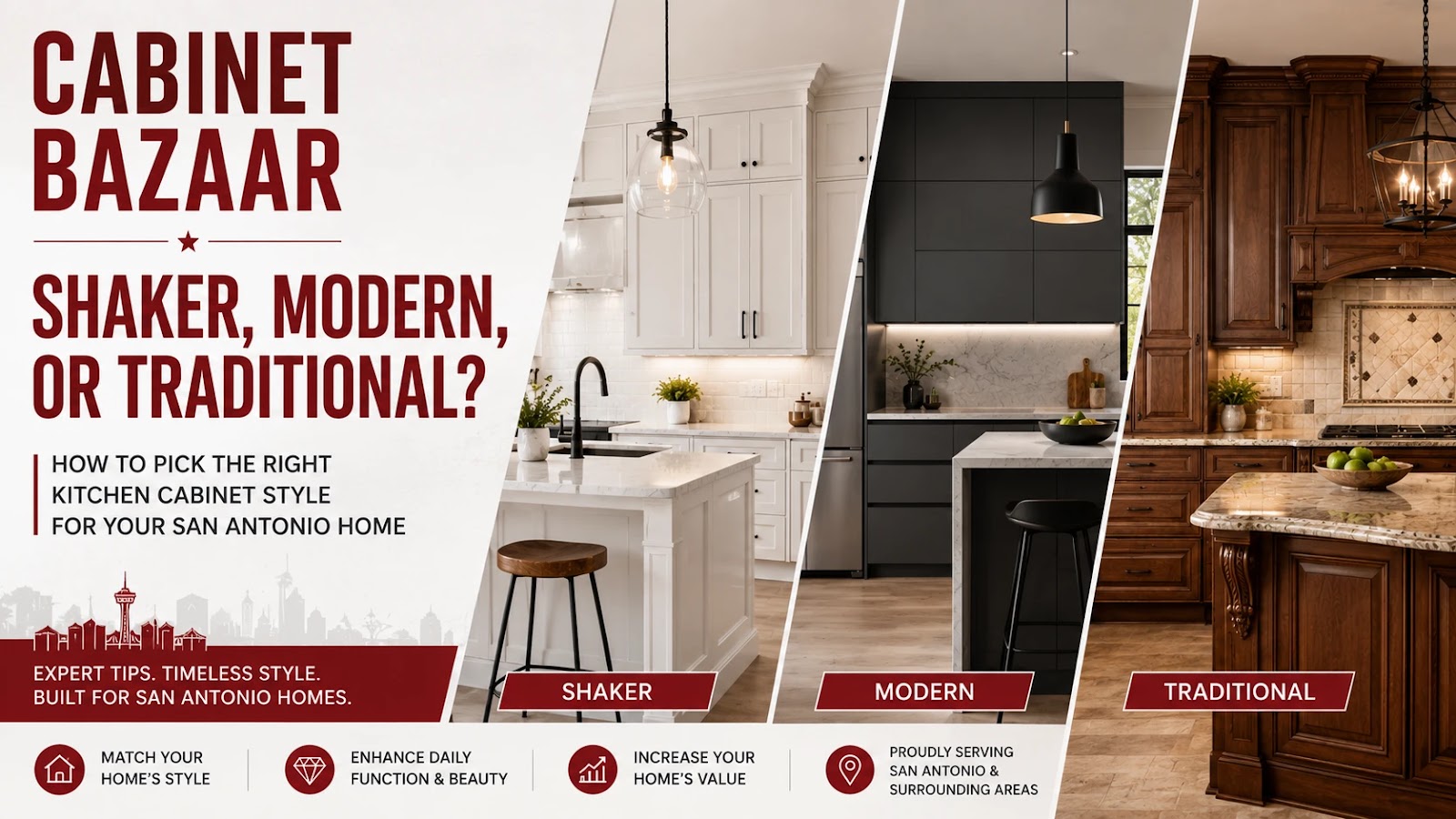
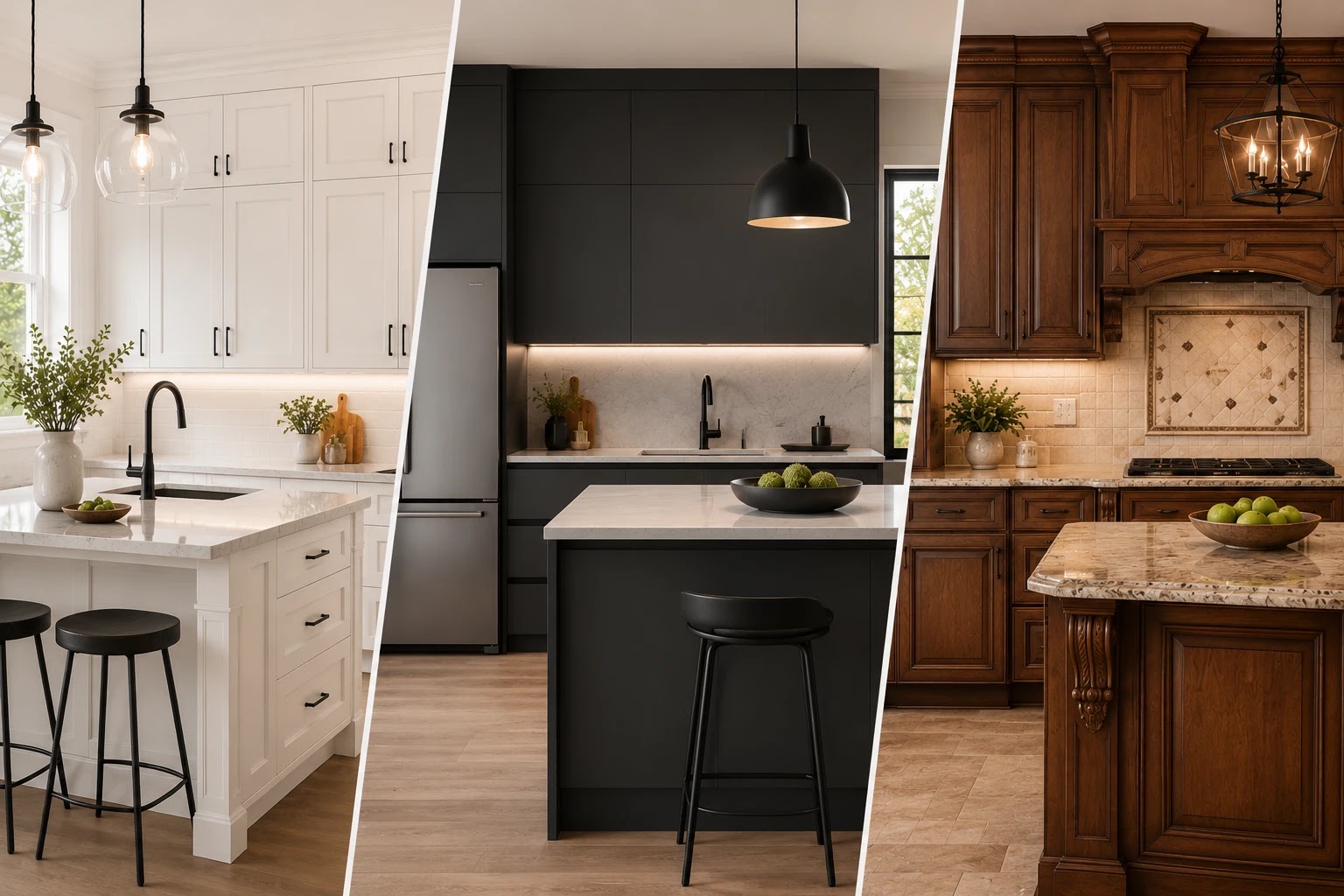
Shaker vs modern vs traditional kitchen cabinet design comparison

Cabinet Finish and Color Guide for Texas Kitchens

Color is the single biggest visual decision in a kitchen remodel. Here’s how the most common choices play out in San Antonio homes:

Color Best Fit Resale Consideration
White Any home style, any size kitchen Strongest resale appeal
Gray / Greige Contemporary and transitional homes Strong, neutral appeal
Navy Blue Larger kitchens with good natural light Trending; risk of dating in 5–7 years
Forest Green Homes with natural materials, wood tones Popular now; longer runway than navy
Natural Wood Tone Hill Country, ranch-style, and modern homes Timeless, especially in warm tones

If you’re not sure which direction to go, white or off-white cabinets are the safest long-term investment in the San Antonio market. They make kitchens feel larger, pair with almost anything, and appeal to the widest range of future buyers.

Hardware: The Detail That Ties Everything Together

Cabinet hardware is often an afterthought, but it does significant visual work in a kitchen. The right pull or knob can update a cabinet without replacing it. The wrong hardware on otherwise beautiful cabinets makes the whole kitchen feel unfinished.

  • Brushed nickel — Versatile and clean. Pairs well with white, gray, and greige cabinets. A safe choice that doesn’t date quickly.
  • Matte black — Popular in modern and transitional kitchens. Works especially well with two-tone cabinets and light countertops. Can look stark in very traditional kitchens.
  • Brushed brass / unlacquered brass — Warm metal tones that work beautifully with wood-stained cabinets and natural stone countertops. Growing in popularity across San Antonio.
  • Oil-rubbed bronze — Pairs well with raised panel cabinets, darker wood tones, and ornate details.
  • Satin brass — A good midpoint between traditional warmth and modern precision.

One practical note: bar pulls on lower cabinets and drawers are easier to grab than knobs, particularly with wet or greasy hands.

How to Match Cabinet Style to Your Home’s Architecture

The best kitchen remodels feel like they belong in the house. Choosing a cabinet style that conflicts with your home’s architecture creates a result that never quite looks finished.

  • Spanish Colonial or Mediterranean — Raised panel cabinets in warm wood tones or off-white painted finishes. Arch details and ornate hardware complement these homes. Avoid ultra-modern flat panel options.
  • Hill Country Ranch — Natural wood tones, knotty alder, or painted cabinets in warm whites and earthy greens. Simple hardware profiles. The goal is organic warmth.
  • Traditional suburban (Stone Oak, Helotes, New Braunfels) — Shaker or raised panel in white or soft gray. Classic hardware in brushed nickel or oil-rubbed bronze. These kitchens need to appeal to a broad resale audience.
  • Modern and contemporary builds — Flat panel cabinets in white, charcoal, or natural wood. Thin bar pulls or handleless doors. Clean, integrated appliances.
  • Craftsman and bungalow — Beadboard or simple Shaker. Painted in warm whites or warm grays. Ceramic or glass knobs can look appropriate here.

Cabinet Storage Features Worth Paying For

Style matters, but the kitchen you actually enjoy living in is one that functions well every day. These storage features consistently make a real difference in kitchen usability:

  • Pull-out shelves in base cabinets — Eliminates the need to kneel and dig through deep lower cabinets. One of the most appreciated upgrades in any remodel.
  • Soft-close hinges and drawer slides — Doors and drawers close quietly and don’t slam. Standard in quality cabinets — worth requesting specifically if it’s not offered.
  • Deep drawer banks — Replacing lower cabinet doors and shelves with deep drawers makes pots, pans, and food storage dramatically more accessible.
  • Corner solutions — Lazy Susans, blind corner pull-outs, and swing-out shelves recover the storage space that corner cabinets traditionally waste.
  • Tall pantry cabinets — For kitchens without a separate pantry, a floor-to-ceiling cabinet provides significant additional storage and helps balance the visual weight of the kitchen.

The Cabinet Bazaar team can walk you through storage upgrade options during your consultation. View our kitchen cabinet collections to start exploring what’s available.

What San Antonio Homeowners Ask Most About Cabinet Styles

What kitchen cabinet style is most popular in San Antonio right now?
Shaker-style cabinets in white or a two-tone combination remain the top choice. They’re versatile, hold resale value, and work across virtually every home style in the area.

How do I choose a cabinet color that won’t look dated in five years?
Stick to neutrals. White, off-white, and warm gray have the longest track records in the San Antonio market. Bold accent colors on lower cabinets can work, but they carry more risk of dating the kitchen.

What’s the difference between semi-custom and custom cabinets?
Semi-custom cabinets are built to order from a manufacturer’s available options. Custom cabinets are designed and built from scratch. Semi-custom offers good flexibility at a lower cost. Custom makes sense for kitchens with unusual dimensions or very specific design requirements.

Can I change cabinet hardware without replacing the cabinets?
Yes. Swapping hardware is one of the most cost-effective ways to update the look of existing cabinets. As long as the new hardware covers the existing holes, it’s a straightforward change.

How do I know if my kitchen needs new cabinets or just a refresh?
If the cabinet boxes are structurally sound and the layout works, fresh paint, new hardware, and updated countertops may be enough. If the boxes are damaged, the layout is inefficient, or the doors are warped, full replacement makes more sense.

FAQ: Cabinet Style Questions From San Antonio Homeowners

Are painted cabinets more popular than stained wood in San Antonio?

Right now, yes. Painted cabinets — particularly white and off-white — dominate the San Antonio market. That said, stained wood tones are seeing a resurgence, particularly warm medium tones like walnut and honey oak. Stained finishes work especially well in Hill Country-adjacent areas and in homes with natural stone or wood floors.

How do I decide between Shaker and raised panel cabinets?

Think about the overall character of your kitchen and home. If your home has a lot of ornate architectural detail, raised panel will fit more naturally. If your home is on the simpler side, Shaker is the more versatile choice. When in doubt, Shaker is the safer bet for long-term resale.

Do flat panel cabinets work in older San Antonio homes?

They can, but the result depends heavily on execution. In an older home with a lot of traditional architectural character, flat panel cabinets can look out of place. In a renovated bungalow or a home that’s been updated throughout, they can work if the rest of the space supports the modern direction.

What hardware finish is easiest to keep clean?

Matte finishes — matte black, brushed nickel, and satin brass — show fingerprints and smudges less than polished finishes. In a busy kitchen, matte hardware generally looks better between cleanings.

How many cabinet styles can I mix in one kitchen?

Most designers recommend keeping it simple. Mixing a standard door style on the majority of cabinets with a contrasting style on a specific element — like an island or a glass-front display section — works well. Mixing three or more styles usually creates visual noise rather than intentional variety.

What cabinet features should I prioritize if I’m remodeling to sell?

White or light neutral painted finishes, Shaker door profiles, brushed nickel or matte black hardware, and soft-close hinges and drawers. These choices appeal to the broadest buyer pool in the San Antonio market and tend to photograph well in listing photos. You can also explore kitchen cabinet design ideas on Houzz for additional inspiration before your consultation.

See the Difference In Person at Cabinet Bazaar San Antonio

Reading about cabinet styles is useful. Seeing them in a real showroom — touching the door profiles, comparing finishes side by side, and talking through your kitchen’s specific layout with someone who knows San Antonio homes — is a completely different experience.

Visit Cabinet Bazaar to explore kitchen cabinets, bathroom vanities, and countertop solutions — or stop by our San Antonio showroom to get started on your kitchen remodel today.

San Antonio Top Kitchen Cabinet Solutions: The Complete 2026 Buyer’s Guide

Replacing or upgrading kitchen cabinets is one of the most consequential decisions in any home renovation. In San Antonio, where kitchens range from compact urban bungalows to sprawling Hill Country custom builds, getting the selection right takes more than a quick showroom visit.

This guide covers what you actually need to know: cabinet types, door styles, material performance in Texas heat, countertop pairings, and realistic budget ranges — all grounded in what works for local homeowners.

White shaker kitchen cabinets installed in a San Antonio home remodel

Why Your Cabinet Choice Sets the Tone for the Whole Kitchen

Cabinets dominate more wall and visual space in a kitchen than almost any other element. They shape how the room feels, how well it functions, and how it photographs when you eventually decide to sell.

In neighborhoods like Alamo Heights or Boerne, the cabinet decision tends to drive everything else — countertop material, hardware finish, tile backsplash. Getting it right first saves costly revisions later.

Beyond appearance, cabinets determine how your kitchen actually works day to day. Storage configuration, drawer depth, door swing patterns, and interior organization systems all come from cabinet design. A beautiful cabinet that wastes space or fights your cooking habits will frustrate you within a month.

So slow down at the start. Understanding your actual storage needs and cooking habits before you choose door styles leads to a better outcome than picking a finish you love and working backward.

The Three Cabinet Types You’ll Encounter in San Antonio Showrooms

When you start shopping for kitchen cabinets in San Antonio, you’ll encounter three main categories. Each one serves a different need and budget.

Stock Cabinets

Stock cabinets are pre-built in standard sizes and shipped from warehouse inventory. They’re the most affordable option and available quickly — often within days. Modern stock cabinet lines have improved significantly in quality and finish variety.

For homeowners in Leon Valley or Schertz working within a firm budget, stock cabinets from a reputable supplier can deliver solid results. The main limitation is sizing. Unusual kitchen dimensions require filler pieces to close gaps, which affects the finished look. Box construction quality varies considerably between stock lines, so ask what materials are used in the cabinet box itself.

Semi-Custom Cabinets

Semi-custom cabinets give you more flexibility in size, finish, and interior configuration while staying more affordable than fully custom work. Lead times are longer than stock — typically two to six weeks — but the fit is usually better and finish options are broader.

For most San Antonio kitchen remodels, semi-custom hits the right balance of quality, flexibility, and value. You get cabinets that fit your kitchen’s actual dimensions without the full cost and lead time of custom work. The quality difference over stock — particularly in box construction and hinge hardware — is noticeable.

Custom Cabinets

Custom cabinets are built to your exact specifications by a cabinetmaker. No size constraints, full control over every detail. This is the right choice for high-end remodels, unusual kitchen layouts, or homeowners who need a specific wood species or finish not available elsewhere.

The tradeoff is lead time — eight to twelve weeks or more — and cost. Custom is significantly more expensive than stock or semi-custom. For homeowners in Stone Oak or the Hill Country fringe where kitchens are larger and design expectations are higher, the investment often makes sense.

Cabinet Door Styles That Work in Texas Homes

Cabinet style sets the overall design direction for your kitchen. Here are the styles getting the most attention from San Antonio homeowners right now.

Shaker Cabinets

Shaker cabinets are the most consistent sellers in Texas kitchens. The clean five-piece door with a recessed center panel works in farmhouse, transitional, and even modern kitchens depending on color and hardware. If you’re not sure what style fits your home, shaker is a reliable starting point that photographs well and appeals to future buyers.

In white or off-white, shaker cabinets suit farmhouse, transitional, and coastal kitchens without looking forced. In navy or sage green, the same door delivers a more contemporary look. Paired with natural wood accents or open shelving, shaker takes on a warmer, more casual character.

Browse kitchen cabinet options at Cabinet Bazaar, or see our full breakdown of kitchen cabinet styles for San Antonio homes for a side-by-side comparison.

Flat-Front (Slab) Cabinets

Flat-front cabinets are the choice for modern and contemporary kitchens. No ornamentation, clean edges, a seamless look that pairs well with quartz countertops and minimalist hardware. In newer San Antonio developments and urban remodels, slab cabinets are increasingly common.

Making flat-front cabinets work requires consistency across the rest of the kitchen design. They demand clean lines throughout — countertop edge profile, backsplash tile, appliance handles.

Raised Panel Cabinets

Traditional and formal, raised panel cabinets suit older homes or projects where the homeowner wants a classic, furniture-like appearance. More ornate than shaker, they require more detailed cleaning along the panel edges — worth considering for busy households.

In San Antonio’s established neighborhoods like Alamo Heights and Terrell Hills, raised panel cabinets often complement the home’s existing architectural details more naturally than contemporary styles would.

Beadboard Cabinets

A softer cottage or coastal look that works well in breakfast nooks, kitchen islands, or homes with a farmhouse theme. Less common than shaker, but effective in the right setting — particularly in homes near the Texas Hill Country.

Luxury kitchen remodel with white shaker cabinets, quartz island countertops, and custom cabinetry showcasing smart kitchen design choices in San Antonio
Modern luxury kitchen featuring custom white shaker cabinets, premium quartz countertops, and timeless design elements that add lasting value to Texas homes.

Cabinet Materials That Hold Up in South Texas Heat

San Antonio’s heat and humidity are a real factor when choosing cabinet materials. Here’s what holds up well in this climate.

Plywood Box Construction

The cabinet box — sides, top, bottom, and back — should be plywood rather than particleboard for any kitchen that sees regular use. Plywood is dimensionally stable, resists moisture better, and holds screws more securely. That matters for hinges and drawer slides over time.

In San Antonio’s summer heat, kitchens can experience temperature swings when the AC cycles off. Plywood handles this better than particleboard, which can swell and distort near sink areas or dishwashers.

MDF Door Fronts for Painted Finishes

MDF (medium-density fiberboard) is a good choice for painted cabinet doors because it doesn’t have wood grain that telegraphs through paint. It’s heavier than solid wood but produces a smoother finished surface. Most painted shaker and slab doors use MDF for exactly this reason.

Solid Wood Doors

For stained or natural-finish cabinets, solid wood doors are the standard. Popular species for San Antonio kitchens:

  • Maple: Smooth, tight grain — takes paint and stain well, one of the most common cabinet wood species
  • Alder: Slightly more rustic character with subtle grain variation
  • Oak: Pronounced, visible grain, very durable — less common in current trends but still requested for traditional kitchens

Thermofoil and Laminate

Budget-friendly options that look good in the right applications. Thermofoil can peel in high-heat areas near ovens over time, so placement matters. Laminate has improved significantly in recent years and performs well in lower-humidity environments. For long-term durability in Texas, plywood boxes with solid wood or MDF painted doors remain the standard recommendation.

How to Pair Cabinets with Countertops

The cabinet-to-countertop relationship is one of the most common points of confusion in kitchen design. A few principles that actually help:

White or light cabinets

White cabinets remain the most popular finish in San Antonio kitchens. They pair with almost any countertop material: white quartz for a bright, clean look; light gray quartz for contrast without drama; butcher block for warmth; or veined natural stone for an upscale feel.

Dark cabinets

Navy, charcoal, forest green, and black have grown in popularity. With dark cabinets, lighter countertops create the contrast that keeps the kitchen from feeling heavy. White or cream quartz, light marble-look porcelain, and natural quartzite all work well here.

Two-tone kitchens

Pairing light upper cabinets with a contrasting island or lower cabinets in a darker shade adds visual depth and lets you incorporate a trending color without committing to it across the entire kitchen.

For countertop options that complement your cabinet choice, explore Cabinet Bazaar’s countertop solutions. You can also read the full material comparison in our best kitchen countertops in San Antonio guide.

What a San Antonio Kitchen Remodel Actually Costs

Cabinet costs vary widely depending on material, kitchen size, and category. A few practical observations:

Kitchen size is the primary cost driver. Linear footage of cabinet runs determines more of the total project cost than anything else. A galley kitchen with 15 to 20 feet of cabinets will cost substantially less than a U-shaped kitchen with 30-plus feet of runs.

Category affects both price and timeline. Stock projects move quickly and cost less per linear foot. Semi-custom offers better sizing flexibility at a moderate premium. Custom is the right call when layout or design requirements can’t be met otherwise — but cost and lead time are significantly higher.

Installation is a separate cost. Removing existing cabinets, preparing walls and floors, leveling, securing, and finishing all add to the total. Having one team handle both supply and installation simplifies project management considerably.

Before requesting quotes, measure your kitchen carefully. Note ceiling height, window and door locations, and appliance positions that affect placement. Accurate measurements let suppliers give precise quotes and reduce surprises. Contact Cabinet Bazaar for a free consultation — we handle both supply and installation for San Antonio homeowners.

What to Know Before You Order Kitchen Cabinets in San Antonio

Measure twice before you order. Cabinet orders are built or cut to your specifications. Returns and remakes are expensive and slow the project. Get accurate measurements of every wall, window, and appliance before visiting a showroom or starting a quote.

Consider your project timeline from the start. Stock cabinets ship fast. Semi-custom and custom have lead times that matter if you have a hard deadline. Confirm lead times before placing an order.

Visit a showroom when possible. Online photos don’t accurately reproduce finish colors. What looks like a warm white online can read as yellow in your kitchen’s lighting. Here’s what to expect when you visit a kitchen cabinet showroom in San Antonio.

Ask what’s included in the base price. Some cabinet lines include soft-close hinges and drawer slides as standard. Others charge extra. Knowing what’s included lets you compare quotes accurately.

Think about interior storage from the start. Pull-out trays, drawer organizers, lazy Susans, and other internal accessories are easier to spec during a cabinet project than to add later.

Get at least two quotes. Pricing varies between cabinet suppliers in San Antonio. A second quote gives you a baseline and sometimes surfaces options you hadn’t considered.

Frequently Asked Questions

What are the most popular kitchen cabinet colors in San Antonio right now?

White and off-white remain the most consistent sellers across San Antonio. Two-tone kitchens pairing white uppers with a colored island base are increasingly popular. Navy, sage green, and warm charcoal are the most requested accent colors in current remodels.

How long does a kitchen cabinet replacement project take in San Antonio?

It depends on cabinet type. Stock projects can move from order to installation in one to two weeks. Semi-custom orders typically take three to six weeks for delivery, with installation completed in one to three days depending on kitchen size. Custom cabinets can take eight to twelve weeks or longer.

Are RTA (ready-to-assemble) cabinets a good option for San Antonio homeowners?

RTA cabinets can work well for homeowners comfortable with assembly or working with a contractor who handles it. Quality varies significantly by brand. Plywood box construction is preferable to particleboard for long-term durability in Texas kitchens. Read our guide on assembled kitchen cabinets in San Antonio for more detail.

Should I replace or reface my kitchen cabinets?

Refacing — replacing door fronts and drawer faces while keeping the existing boxes — makes sense when boxes are solid but the doors look dated. If boxes show water damage, structural issues, or poor layout, full replacement is the better long-term investment.

What should I look for in a kitchen cabinet store in San Antonio?

Look for a showroom where you can see finishes in person, a team that can help with layout planning, clear lead times and pricing, and installation services. A supplier who handles both product and installation reduces coordination headaches and accountability gaps during the project.

Do kitchen cabinets add value to a San Antonio home?

Kitchen remodels consistently rank among the highest-return home improvement projects. According to Remodeling Magazine’s Cost vs. Value Report, kitchen updates including cabinet replacement return a meaningful percentage of investment at resale. In San Antonio’s active real estate market, an updated kitchen with quality cabinets is a significant selling point.

Ready to Start? Visit Cabinet Bazaar in San Antonio

Choosing kitchen cabinets in San Antonio doesn’t have to be complicated. Start with your budget range and kitchen dimensions, decide between stock, semi-custom, or custom based on your timeline and design goals, and choose a style that fits both your home’s character and your actual cooking habits.

Cabinet Bazaar’s showroom works with Texas homeowners on everything from straightforward stock replacements to full kitchen remodels. Visit the showroom, explore kitchen cabinet collections, or request a free consultation to get your project started today.

Kitchen Cabinet Styles for San Antonio Homes: How to Choose the Right Look, Material, and Finish

Choosing the right kitchen cabinets is one of the most important decisions in any kitchen remodel. With so many designs, materials, and finishes available, finding the perfect balance between style, durability, and functionality can feel overwhelming. Understanding the most popular kitchen cabinet styles for San Antonio homes can help you create a space that complements your home’s architecture, reflects your personal taste, and stands up to the demands of everyday living in South Texas.

The problem is not the options, it is the context. A cabinet door that looks great in isolation can feel completely wrong when installed against your countertops, backsplash, and flooring. Getting this right requires understanding what each style actually does inside a real kitchen, not just how it looks on a display board.

San Antonio homeowners face a particular challenge here. The city has an unusually diverse mix of home styles, Spanish Colonial homes in King William, Hill Country ranch builds in Boerne and Helotes, modern townhomes near the Pearl District, and traditional suburban layouts throughout Stone Oak, Schertz, and Cibolo. No single cabinet style fits all of these contexts.

This guide walks through the process of choosing kitchen cabinets the right way, starting with style fundamentals and working through to the specific decisions that determine how your finished kitchen will look and function.

What “Kitchen Cabinet Style” Actually Means

When designers and retailers talk about cabinet style, they are referring primarily to the door profile, the shape, frame detail, and surface treatment of the cabinet door. This is what you see most when you look at a kitchen. Everything else (the box construction, the interior fittings, the hardware) matters, but the door profile sets the visual tone.

Cabinet style also encompasses finish, painted versus stained versus thermofoil, and the hardware you choose. These three elements together (door profile, finish, hardware) determine whether your kitchen reads as traditional, transitional, or contemporary.

Understanding these layers helps you make better decisions at the showroom. Instead of reacting to what looks good in isolation, you can evaluate how each choice interacts with the other decisions you have already made — or will need to make.

The Five Cabinet Styles San Antonio Homeowners Choose Most

Kitchen cabinet styles guide for San Antonio homeowners featuring shaker, raised panel, flat panel, beadboard, and glass front cabinets-Kitchen Cabinet Styles for San Antonio Homes

Shaker-Style Cabinets: The Most Versatile Option

Shaker is the defining cabinet style of the current era. The five-piece door with a flat center panel and clean square edges has been popular for over a decade, and it has not burned out. Part of the reason is its versatility — shaker cabinets work in traditional kitchens, transitional kitchens, and modern farmhouse designs. They pair with virtually any countertop material.

In San Antonio, white painted shaker cabinets remain the top request. Two-tone applications — white shaker uppers paired with a painted lower cabinet in navy, green, or charcoal — have grown consistently popular over the past few years and hold up well in Texas-style homes across the city.

Browse shaker kitchen cabinet options at Cabinet Bazaar to see the full range of door profiles, painted finishes, and stain options currently available.

Raised Panel Cabinets: Traditional Character with Formal Appeal

Raised panel cabinets have a center panel that projects outward from the door frame. This creates depth and shadow lines that give the kitchen a more formal, traditional look. They pair naturally with granite countertops, ornate hardware, and decorative range hoods.

Raised panel cabinets are particularly popular in older San Antonio neighborhoods and in homes with more formal architectural detailing. If your home has crown moldings, arched doorways, or decorative tilework, raised panel cabinets tend to feel more at home than shaker.

Flat Panel (Slab) Cabinets: Clean Lines for Modern Kitchens

Flat panel, or slab-style, cabinets have no frame detailing. The door is a single flat surface. This is the foundation of modern and contemporary kitchen design. Paired with integrated handles, handleless push-to-open hardware, or thin bar pulls, slab cabinets create a clean, European-inspired look.

This style has gained traction in newer San Antonio developments and in open-concept homes where the kitchen flows into living areas. The minimal design can feel cold if not balanced with warm materials elsewhere — wood tones, natural stone, or warm lighting tend to anchor it well.

Beadboard Cabinets: Casual Farmhouse Charm

Beadboard cabinets feature vertical groove detailing on the door panel. They are associated with cottage, farmhouse, and coastal design aesthetics. In San Antonio, beadboard works well in older craftsman-style homes or in kitchens going for a relaxed, casual feel. It is less common in contemporary builds.

Glass Front Cabinets: Visual Interest and Display Potential

Glass front cabinets are not a standalone door profile — they are a variation applied to any style. Replacing solid door panels with glass panes on upper cabinets adds visual interest, makes a kitchen feel more open, and allows you to display dishes or glassware. This works best when the interior of the cabinet is well-organized and attractively stocked. A cluttered cabinet behind glass reads worse than a solid door would have.

Cabinet Finish and Color Guide for Texas Kitchens

Color is the single biggest visual decision in a kitchen remodel. Here is how the most common choices play out in San Antonio homes.

Color Best Fit Resale Consideration
White Any home style, any size kitchen Strongest resale appeal
Gray / Greige Contemporary and transitional homes Strong, neutral appeal
Navy Blue Larger kitchens with good natural light Trending; risk of dating in 5–7 years
Forest Green Homes with natural materials and warm tones Growing trend; best as accent lower cabinets
Natural Wood Stain Ranch, Hill Country, and rustic styles Timeless in the right context
Two-Tone Any style with enough visual weight to handle contrast Popular now; depends on execution

A note on paint quality: cabinets in San Antonio kitchens take wear. Texas heat and humidity cycles put stress on painted surfaces. If you are choosing a painted finish, ask specifically about the topcoat and how it handles cleaning, humidity, and temperature variation. This question alone can help you separate quality cabinet lines from budget options that look similar at the showroom.

Explore cabinet finish options for San Antonio kitchens at Cabinet Bazaar, where you can compare painted, stained, and specialty finishes in person.

Kitchen Cabinet Styles for San Antonio Homes-San Antonio kitchen cabinet design guide with shaker cabinets, cabinet finishes, storage features, and hardware recommendations

Hardware: The Detail That Ties the Kitchen Together

Hardware is where a lot of kitchens either come together or fall apart. The wrong hardware on the right cabinets makes the whole kitchen feel unfinished. Here are the most common hardware finishes and what they work well with.

  • Brushed nickel: Versatile and clean. Pairs well with white, gray, and greige cabinets. A safe choice that does not date quickly.
  • Matte black: Popular in modern and transitional kitchens. Works especially well with two-tone cabinets and white or light countertops. Can look stark in very traditional kitchens.
  • Brushed brass / unlacquered brass: Warm metal tones that work beautifully with wood-stained cabinets and natural stone countertops. Growing in popularity across San Antonio.
  • Oil-rubbed bronze: A traditional finish that pairs well with raised panel cabinets, darker wood tones, and ornate details.
  • Satin brass: Similar to brushed brass but with a slightly more polished finish — a good midpoint between traditional warmth and modern precision.

One practical note: bar pulls on lower cabinets and drawers are easier to grab quickly than knobs, particularly with wet or greasy hands. Function matters as much as appearance in a working kitchen.

How to Match Cabinet Style to Your Home’s Architecture

The best kitchen remodels feel like they belong in the house. Choosing a cabinet style that conflicts with your home’s architecture creates a result that never quite looks finished — even when the individual components are good quality. Here is how the most common San Antonio home styles translate to cabinet choices.

  • Spanish Colonial or Mediterranean: Raised panel cabinets in warm wood tones or off-white painted finishes. Arch details and ornate hardware complement these homes. Ultra-modern flat panel options tend to clash.
  • Hill Country Ranch: Natural wood tones, knotty alder, or painted cabinets in warm whites and earthy greens. Simple hardware profiles. The goal is organic warmth, not precision.
  • Traditional suburban (Stone Oak, Helotes, New Braunfels): Shaker or raised panel in white or soft gray. Classic hardware in brushed nickel or oil-rubbed bronze. These kitchens need to appeal to a broad resale audience.
  • Modern and contemporary builds: Flat panel cabinets in white, matte gray, or wood-tone veneer. Integrated handles or thin bar pulls. Minimal ornamentation throughout.
  • Craftsman and bungalow styles: Shaker cabinets are a natural fit. Warm stain options, simple square hardware, and wood-tone accents all work well in these spaces.

If you are unsure about your home’s style category, the Cabinet Bazaar team in San Antonio can help you identify what will work best for your specific layout, neighborhood, and budget.

Cabinet Storage Features Worth Paying For

Storage features do not affect how a kitchen looks in photos, but they have a significant impact on how it works day to day. These are the upgrades most worth considering during a San Antonio kitchen remodel.

  • Pull-out shelves in base cabinets: Eliminates the need to kneel and dig through deep lower cabinets. One of the most appreciated upgrades in any kitchen remodel — particularly in larger Texas-style kitchens where base cabinets run deep.
  • Soft-close hinges and drawer slides: Doors and drawers close quietly without slamming. This is standard in quality cabinets — worth requesting specifically if it is not offered by default.
  • Deep drawer banks: Replacing lower cabinet doors and shelves with deep drawers makes pots, pans, and food storage dramatically more accessible.
  • Corner solutions: Lazy Susans, blind corner pull-outs, and swing-out shelves recover the storage space that corner cabinets traditionally waste.
  • Tall pantry cabinets: For kitchens without a separate pantry, a floor-to-ceiling cabinet provides significant additional storage and helps balance the visual weight of the kitchen.

The Cabinet Bazaar team can walk you through storage upgrade options during your showroom visit — many of these features are available across multiple price points, not just premium lines.

Quick Answers to Common Cabinet Questions

What cabinet style adds the most value to a San Antonio home?

Shaker-style cabinets in white or a two-tone combination tend to hold resale value best. They work across virtually every home style in the area, and buyers recognize them as a quality choice without the polarizing reaction that more style-specific options can generate.

What finishes are most durable in the Texas climate?

San Antonio’s heat and humidity cycles are hard on cabinet finishes. Thermofoil can peel near heat sources. Low-quality painted finishes can crack or yellow over time. Look for cabinets with a catalyzed or conversion varnish topcoat if you are choosing painted. For wood stains, ask specifically about how the finish is sealed against moisture.

What is the difference between semi-custom and custom cabinets?

Semi-custom cabinets are built to order from a manufacturer’s available options. Custom cabinets are designed and built from scratch for your specific kitchen. Semi-custom offers solid flexibility at a lower cost. Custom makes sense for kitchens with unusual dimensions or very specific design requirements.

Can I update hardware without replacing the cabinets?

Yes. Swapping out hardware is one of the most cost-effective ways to update the look of existing cabinets. As long as the new hardware matches the existing hole spacing, it is a straightforward swap. Going from knobs to bar pulls usually requires drilling new holes, but it is still a relatively simple project.

FAQ: Cabinet Style Questions from San Antonio Homeowners

Which kitchen cabinet style is most popular in San Antonio right now?

Shaker-style cabinets in white or a two-tone combination remain the top choice. They are versatile, hold resale value, and work across virtually every home style in the area.

How do I choose a cabinet color that will not look dated in five years?

Stick to neutrals. White, off-white, and warm gray have the longest track records in the San Antonio market. Bold accent colors on lower cabinets can work, but they carry more risk of dating the kitchen over time.

Do I need custom cabinets for an unusual kitchen layout?

Not necessarily. Semi-custom options cover most non-standard layouts. Full custom makes sense when you have genuinely unusual dimensions — very high ceilings, irregular wall angles, or a layout that stock sizing cannot accommodate. A showroom consultation is the fastest way to know which category your kitchen falls into.

Are there cabinet styles that work better in smaller San Antonio kitchens?

Light painted finishes (white, off-white, light gray) make small kitchens feel larger. Flat panel doors reduce visual clutter. Glass front uppers can open up a tight space if the interior is organized. Avoid very dark colors in small kitchens — they absorb light and reduce the perceived size of the room.

Ready to Choose the Right Cabinets for Your San Antonio Kitchen?

Reading about cabinet styles is useful. Seeing them in a real showroom — touching the door profiles, comparing finishes side by side, and talking through your kitchen’s specific layout with someone who knows San Antonio homes — is a different experience entirely.

Visit Cabinet Bazaar to explore kitchen cabinets, bathroom vanities, and countertop solutions, or stop by our San Antonio showroom to see the full collection in person. Our team works with homeowners across San Antonio, Boerne, Helotes, New Braunfels, and surrounding areas.

The right cabinets for your kitchen come down to three things: style that fits your home’s architecture, a finish that holds up in the Texas climate, and storage features that make the kitchen easier to use every day. Start with those three priorities, and the rest of the decisions get easier.

San Antonio’s Top Kitchen Cabinet Solutions: The Complete Buyer’s Guide for Texas Homeowners

If you’ve ever stood in your kitchen and thought, “Something about this just isn’t working,” — chances are the cabinets are the problem. In most kitchens, cabinetry takes up more visual space than anything else. It sets the tone, determines how functional the space feels, and directly impacts how much your home is worth.

For homeowners in San Antonio, this decision carries extra weight. The real estate market here is active, and kitchen remodels consistently deliver strong returns. More importantly, families in this city spend a lot of time in the kitchen. Whether you’re in Stone Oak, Alamo Heights, Helotes, or Schertz — you deserve a kitchen that actually works for how you live.

This guide walks you through San Antonio’s top kitchen cabinet solutions so you can make a confident, well-informed decision before spending a single dollar.

What Makes a Kitchen Cabinet Solution “Top Tier” in San Antonio

Not every cabinet you find at a big-box store belongs in a San Antonio home. Top-tier kitchen cabinet solutions share a few traits that are especially relevant in this region.

Built to Handle Texas Heat and Humidity

San Antonio summers are no joke. Wood cabinets that aren’t properly sealed or constructed can warp, crack, or swell over time. Top cabinet solutions use moisture-resistant materials and quality finishes designed to hold up year-round in the Bexar County climate.

Style That Fits the Way Texans Live

Kitchens across San Antonio range from Spanish Colonial and Hill Country ranch-style to sleek modern builds in master-planned communities. Good cabinet solutions come in styles versatile enough to match these aesthetics — without looking like they were designed for a generic suburban home in another state.

Value That Actually Makes Sense

San Antonio homeowners are savvy. The best cabinet solutions aren’t always the most expensive — they’re the ones that deliver quality construction, functional storage, and attractive design at a price point that makes real sense for your budget and your home’s value.

Local Availability and Real Support

Ordering cabinets online from out of state and hoping they arrive intact is not a plan. The best solutions come with local expertise, real showroom access, and professionals who understand San Antonio home styles and construction.

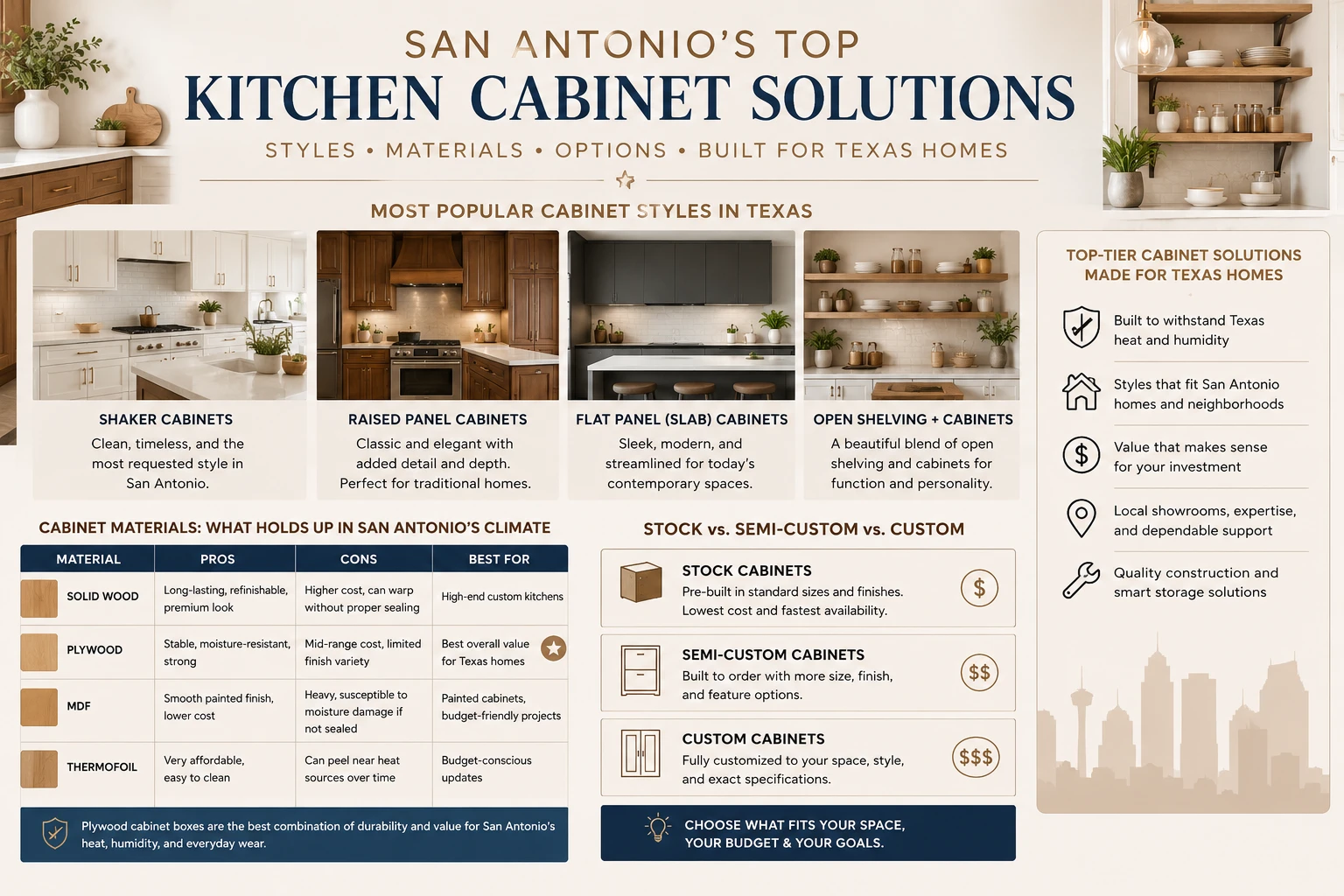
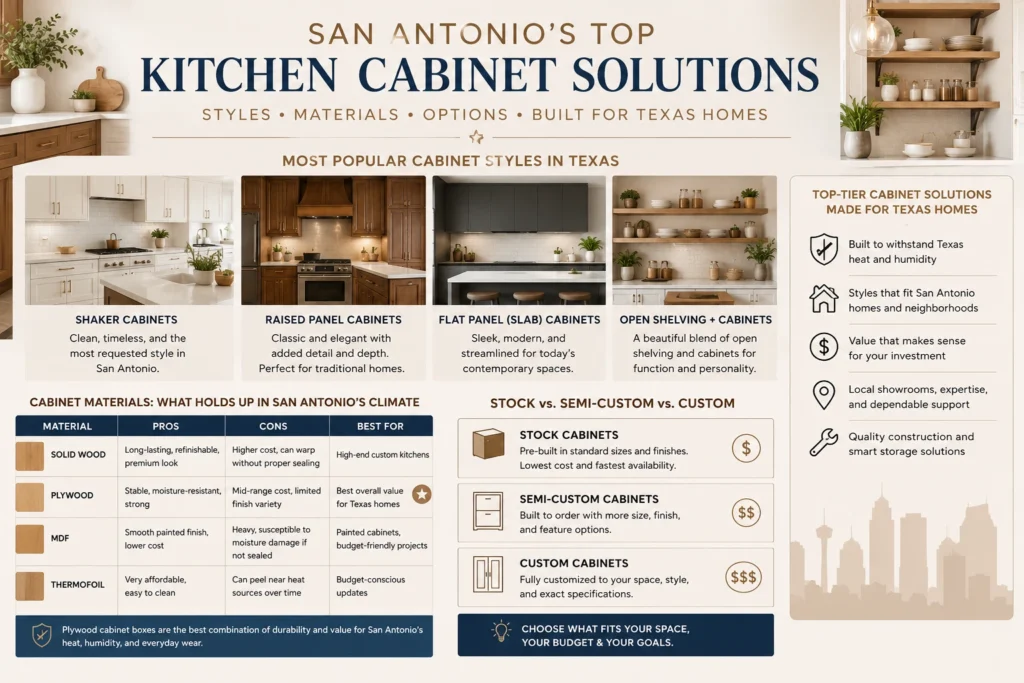
The Most Popular Cabinet Styles in San Antonio Kitchens

Choosing a cabinet style is the most personal part of any kitchen remodel. Here’s a breakdown of the styles San Antonio homeowners consistently choose — and why.

Shaker Cabinets — The Style That Never Gets Old

Shaker cabinets are the most requested style in San Antonio right now. They feature a five-piece door with a recessed center panel — clean, unfussy, and versatile enough for both traditional and modern kitchens. White shaker cabinets remain the most popular finish choice, though painted sage green and navy blue options have grown considerably in the past few years.

Raised Panel Cabinets for a Classic Texas Look

Raised panel cabinets offer more visual depth and a classic, formal appearance. They pair especially well with traditional Texas home styles and granite or quartz countertops. Many homeowners in Alamo Heights and Terrell Hills gravitate toward this style for its timeless character.

Flat Panel (Slab) Cabinets for Modern Kitchens

For homeowners going full modern, flat panel cabinets deliver a streamlined, European-inspired look. They work well in newer builds and open-concept kitchens where clean lines are the priority. Matte finishes in charcoal, white, or natural wood tones are the most popular choices in San Antonio’s newer developments.

Mixing Open Shelving With Traditional Cabinets

A growing number of San Antonio homeowners are mixing traditional upper cabinets with a section of open shelving. This approach adds personality, keeps frequently used items accessible, and breaks up the visual weight of wall-to-wall cabinetry — especially in smaller kitchens.

Cabinet Materials That Hold Up in the San Antonio Climate

Material selection matters more in Texas than in most other states. Here’s a straight look at what holds up — and what doesn’t.

Material Pros Cons
Solid Wood Long-lasting, refinishable, premium look Higher cost; can warp without proper sealing
Plywood Stable, moisture-resistant, strong Mid-range cost; limited finish variety
MDF Smooth painted finish, lower cost Heavy; susceptible to moisture damage if not sealed
Thermofoil Very affordable, easy to clean Can peel near heat sources over time

For San Antonio homes, plywood cabinet boxes are widely considered the best combination of durability and value. The Bexar County climate — with its humidity spikes and temperature swings — makes plywood construction significantly more reliable than particleboard for the long term.

Stock, Semi-Custom, or Custom — Which One Is Right for You?

One of the most common questions from San Antonio homeowners is whether to go stock, semi-custom, or fully custom. Here’s a straightforward breakdown.

Stock Cabinets: Fast, Affordable, and Often Underrated

Stock cabinets are pre-built in standard sizes and finishes. They’re available quickly, come at the lowest cost, and are a solid choice for straightforward kitchen layouts. Cabinet Bazaar carries a wide selection of stock cabinets at accessible price points — and many homeowners are pleasantly surprised by the quality on offer.

Semi-Custom Cabinets: More Flexibility Without the Custom Price Tag

Semi-custom cabinets are built to order with more size and finish options. They’re ideal for kitchens with non-standard dimensions or homeowners who want specific features — like pull-out shelves, soft-close hinges, or specific door profiles. This is where most San Antonio homeowners land, and for good reason.

Custom Cabinets: Designed Exactly for Your Kitchen

Custom cabinets are designed and built from scratch to fit your exact kitchen and preferences. They’re the highest cost option — but for complex kitchens or high-end remodels, they’re often worth every dollar. If you’re working with a standard kitchen layout in a neighborhood like Leon Valley or Cibolo, stock cabinets may serve you just as well at a fraction of the price.

Countertop Pairings That Work Best With Your New Cabinets

Cabinets and countertops have to work together. Here are the pairings San Antonio homeowners find most successful.

  • White shaker cabinets + quartz in white or gray: A clean, timeless combination that photographs well and holds resale value.
  • Natural wood tone cabinets + quartzite or leathered granite: A warm, organic pairing that reads as high-end without feeling cold.
  • Navy or dark green cabinets + light marble or white quartz: Bold contrast that works beautifully in larger kitchens with good natural light.
  • Gray flat-panel cabinets + concrete-look quartz: A modern, urban aesthetic popular in newer San Antonio builds.

Quartz countertops are consistently the top choice among San Antonio homeowners because they require minimal maintenance and resist staining. Explore countertop options at Cabinet Bazaar to find the right surface to complement your new cabinets.

What San Antonio Homeowners Should Know Before Installation

Even the best cabinets won’t perform well if installation is rushed or done incorrectly. Here’s what matters most before your project begins.

Level Floors Are Rarer Than You Think

San Antonio homes — particularly older ones in the central city — often have floors that aren’t perfectly level. A good installer accounts for this and ensures your cabinet run is perfectly plumb, even when the floor isn’t cooperating.

Upper Cabinets Need Proper Stud Anchoring

Cabinets filled with dishes and small appliances can get surprisingly heavy. Upper cabinets must be anchored into wall studs — not just drywall. This is non-negotiable for safety and long-term stability.

Plan for a Realistic Timeline

A full kitchen cabinet installation typically takes two to five days depending on kitchen size and complexity. Don’t plan around a one-day turnaround — and remember that trim, crown molding, toe kicks, and hardware all add time and cost to the project.

Cabinet Bazaar offers professional cabinet installation services in San Antonio. Our team handles the full process from delivery to finish trim — so you don’t have to coordinate multiple contractors.

Expert Quick-Answer Guide: What Every San Antonio Homeowner Needs to Know

Before you start your remodel, here are direct answers to the questions homeowners in San Antonio ask most often.

What Is the Most Durable Cabinet Material for San Antonio’s Climate?

Plywood-box cabinets with solid wood or MDF doors and a sealed finish hold up best in San Antonio’s heat and humidity cycles. Avoid particleboard boxes if you’re planning for the long term.

White shaker kitchen cabinets installed in a San Antonio home remodel

How Long Does a Kitchen Cabinet Remodel Take?

Most kitchen cabinet projects in San Antonio take one to three weeks from order to installation, depending on whether you choose stock or semi-custom. Full custom cabinets can take six to twelve weeks.

What Cabinet Style Adds the Most Resale Value?

Shaker-style cabinets in white or light neutral tones consistently perform best for resale value in the San Antonio real estate market. They appeal to the widest range of buyers and never feel dated.

Are RTA Cabinets Worth Considering?

Ready-to-assemble (RTA) cabinets can be a strong budget option for homeowners comfortable with DIY assembly. Quality varies widely — so it’s worth examining the construction closely before committing.

Quartz vs. Granite: Which Should You Choose?

Quartz requires less maintenance and is non-porous, which makes it ideal for busy family kitchens. Granite offers a completely natural look with unique patterns. For most San Antonio homeowners, quartz is the more practical everyday choice.

Ready to Transform Your Kitchen? Here’s Your Next Step

Your kitchen is the most used room in your home. Choosing San Antonio’s top kitchen cabinet solutions means thinking beyond looks — it means considering durability in the Texas climate, materials that hold up under daily use, styles that work with your home’s character, and a team that actually knows the San Antonio market.

Whether you’re doing a full kitchen remodel or simply replacing worn-out cabinets, the right choice starts with seeing your options in person, asking the right questions, and working with people who understand what makes a great kitchen in this city.

Stop guessing and start planning. Cabinet Bazaar’s San Antonio showroom gives you the chance to see cabinet styles, finishes, countertop options, and hardware in person. Our team can help you build a solution that fits your kitchen, your family’s needs, and your budget.

Visit our showroom at cabinetbazaar.com or call to schedule a free kitchen remodeling consultation today.

FAQ:

How Much Does a Kitchen Cabinet Remodel Cost in San Antonio?

Cabinet costs vary significantly based on type and kitchen size. Stock cabinets for an average-sized kitchen can run a few thousand dollars. Semi-custom and custom projects scale up from there. The best way to get an accurate number for your specific kitchen is to visit a showroom or request a consultation — there’s no guesswork involved when you have real samples in front of you.

Where Can I See Kitchen Cabinet Samples in San Antonio?

Cabinet Bazaar has a showroom in San Antonio where you can view cabinet styles, finishes, and countertop samples in person. Seeing materials under natural light makes a significant difference in decision-making — photos on a screen don’t do them justice. You can also explore collections online at cabinetbazaar.com.

What Is the Best Kitchen Cabinet Brand for San Antonio Homeowners?

There isn’t a single “best” brand that fits every homeowner. The right choice depends on your budget, style preference, and kitchen layout. What matters most is construction quality: solid plywood boxes, soft-close hardware, and a finish that holds up under daily use.

Can I Install Kitchen Cabinets Myself?

DIY cabinet installation is possible for homeowners with solid carpentry skills and the right tools. That said, most San Antonio homeowners find that professional installation protects their investment and delivers better results — particularly for upper cabinets and any work involving plumbing or electrical coordination.

What Cabinet Colors Are Trending in San Antonio Right Now?

White remains the most popular choice across the board. Two-tone kitchens — with white or light upper cabinets and a darker or bolder lower cabinet color — have grown significantly in popularity. Navy blue, forest green, and warm greige lower cabinets are among the most frequently requested finishes at Cabinet Bazaar’s San Antonio showroom.

Do I Need to Replace My Countertops When I Replace My Cabinets?

Not necessarily — but it’s worth evaluating. If your current countertops are in good condition and complement your new cabinet style, keeping them is reasonable. However, many homeowners find that new cabinets make their existing countertops look dated, and replacing both at the same time allows for a more cohesive result.

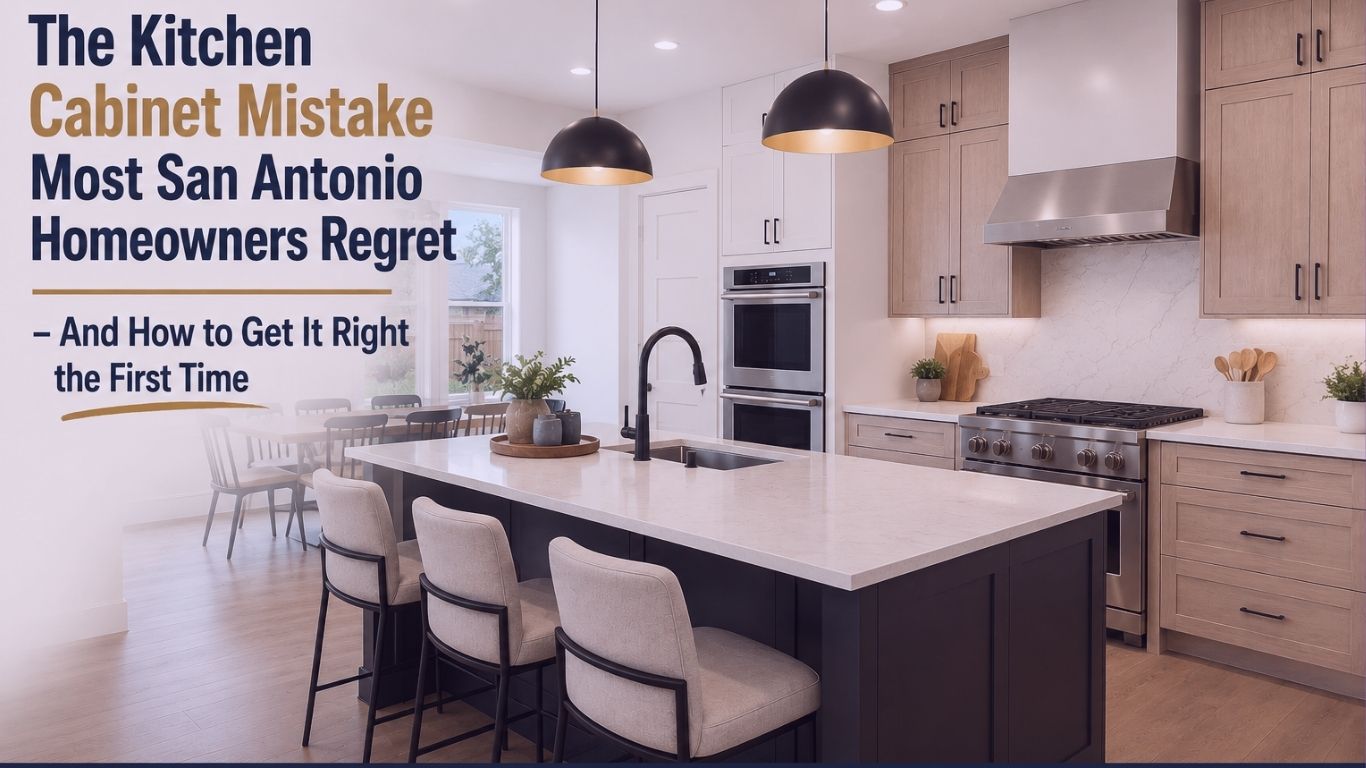
The Kitchen Cabinet Mistake Most San Antonio Homeowners Regret – And How to Get It Right the First Time

Choosing Kitchen Cabinets Is Harder Than It Looks:


Most people spend more time picking a paint color than they do thinking through their cabinet style. That makes sense on the surface: paint is cheap to change, and cabinets look like cabinets. But cabinets are the single most visible element in a kitchen. They set the tone for everything else. Get the style wrong and you’ll feel it every morning when you walk in.


This guide walks through the most common cabinet styles available in San Antonio, how to match them to your home, what they cost, and what questions to ask before you commit. If you’ve been putting off a kitchen refresh because the options feel overwhelming, this should help narrow things down.


Why Cabinet Style Matters More Than You Think


Here’s something most remodeling guides skip over: Cabinet doors are the first thing your eye lands on when you enter a kitchen. Not the countertops, not the backsplash. The cabinets. That means the style, finish, and color you choose will define how every other element reads in the room.


A white shaker cabinet makes a quartz countertop look clean and modern. That same quartz next to a dark wood European flat-front cabinet reads differently. It’s not that one is wrong. It’s that they tell different stories, and only one of those stories fits your home.


The National Kitchen and Bath Association consistently reports that kitchen remodels are among the top three home improvement projects that affect resale value. Getting your cabinet style right is not just about aesthetics: it’s a financial decision.


The Most Popular Cabinet Styles in San Antonio Kitchens Right Now:

Shaker Cabinets: The One That Works in Almost Any Kitchen

Shaker cabinets have been the dominant style in American kitchens for over a decade, and there’s a straightforward reason for that. The recessed center panel creates just enough visual detail without committing to a particular era or aesthetic. They work in farmhouse kitchens, transitional spaces, and even contemporary layouts, depending on the hardware you pair with them.


Cabinet Bazaar carries several shaker variations:


  • Shaker White is the most requested finish. It makes small kitchens feel larger and pairs cleanly with quartz countertops in white or light gray.
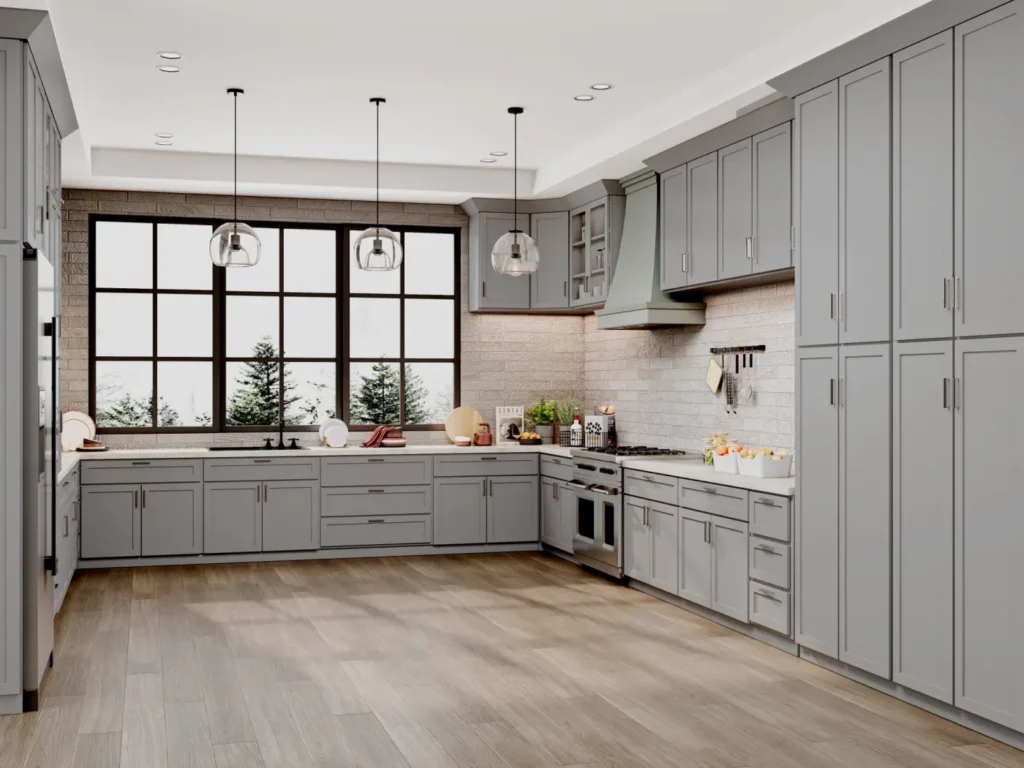
  • Shaker Gray has become a strong alternative for homeowners who want the versatility of shaker without the starkness of white. It reads as neutral without feeling cold.
  • Shaker Navy Blue is the choice for lower cabinets or kitchen islands where you want a color accent. It tends to pair well with brass or matte black hardware.
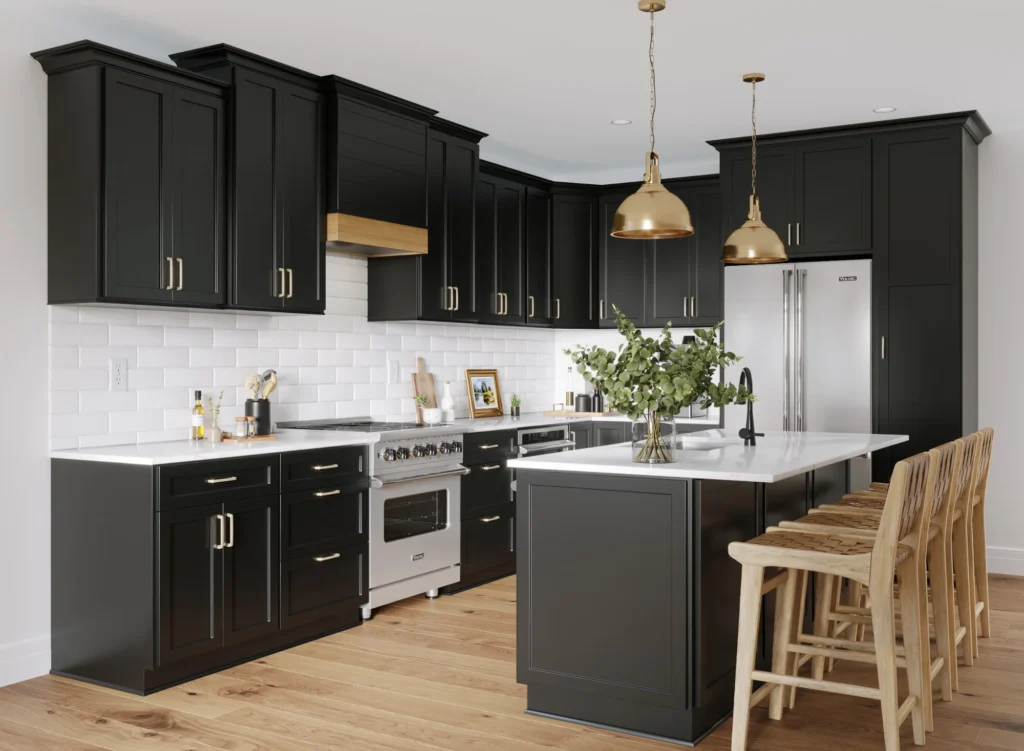
  • Shaker Cinder is a deeper charcoal option for kitchens that lean toward a moody, dramatic palette.
  • Shaker Wood brings in natural grain texture for a warmer feel without going full traditional.


If you’re not sure where to start, a shaker is usually the right default. You can see how these compare in the Cabinet Bazaar gallery before making a decision.

For more on what gray Shaker cabinets look like in San Antonio homes specifically, the Cabinet Bazaar blog post on gray shaker cabinets covers shade comparisons and cost in detail.

European Dark Wood: For Kitchens That Want to Make a Statement:


The European Dark Wood style is a flat-front cabinet with a rich, dark finish. No center panel, no decorative detail. The look is clean and intentional. It’s suited to kitchens that have strong architectural elements to work with: large windows, concrete or stone floors, and open-plan layouts.


This style tends to divide opinions. Some homeowners find it too dramatic. Others find everything else looks dated next to it. The honest answer is that it depends on what the rest of your space is doing. If your home leans contemporary, a European flat-front is worth considering seriously. If your home has traditional trim and detailed millwork, it may clash more than complement.


According to research published by Houzz, dark and two-tone kitchen designs have been gaining ground in recent years, with homeowners increasingly willing to use deep tones on lower cabinets while keeping upper cabinets light. That’s a direction the European Dark Wood style supports well.

Franklin Series: A Step Between Traditional and Transitional:


The Franklin collection sits between a traditional raised-panel look and the cleaner shaker profile. It’s a good fit for homes that have more detail in the moldings and architecture but where the owner doesn’t want to go fully ornate.


  • Franklin White is the lighter option and tends to photograph well in kitchen listings.
  • Franklin Gray brings a bit more warmth and works particularly well in kitchens with warmer-toned countertops.

Bristol Beige: When Warm Neutrals Are the Right Move

The Bristol Beige style tends to get overlooked in favor of white or gray. That’s a mistake for certain kitchens. If your home gets a lot of natural light, or if you’re pairing cabinets with a butcher block or wood-toned countertop, a warm beige reads better than a cool white. It also ages more gracefully in high-traffic kitchens where fingerprints are a daily reality.


Slim Green: For the Kitchen That Doesn’t Want to Blend In

The Slim Green option is more specific in its application. Greens have been a rising trend in kitchen design, and a saturated green cabinet done well looks intentional and current. It pairs well with brass hardware and light natural stone countertops. It’s not for every kitchen, but for the ones where it works, it tends to be the best version of that kitchen.


Matching Cabinet Style to Your Home’s Architecture:


San Antonio homes span a wide range of styles: 1970s ranch houses, newer suburban builds, Craftsman bungalows, Spanish colonial revival, and modern new construction in the Hill Country edge of the metro. The cabinet style that works in one won’t necessarily work in another.


A few general principles:


Ranch and suburban homes tend to do well with shaker styles. They’re flexible enough to work in either direction and won’t look out of place with standard ceiling heights and neutral finishes.


Craftsman and traditional homes lean toward the Franklin collection or a wood-toned shaker option. The detailed millwork in those homes wants something with a bit more visual weight than a flat-front cabinet.


Contemporary or new construction is where European flat-front and Slim collections have room to work. Clean lines, flat surfaces, and minimal hardware fit the aesthetic of those spaces.


Older homes with limited natural light often benefit from lighter finishes: Shaker White, Franklin White, or Bristol Beige. Dark cabinets can make a low-light kitchen feel smaller than it is.


The Cabinet Bazaar design service includes a 3D rendering so you can see how a specific style will look in your space before you commit. That service alone saves most homeowners from at least one expensive mistake.


What About Countertops?

Cabinets and countertops have to work together. Cabinet Bazaar carries both, which makes the pairing process easier. You can see the full countertop options alongside the cabinet styles you’re considering.


Some general pairing notes:


  • White quartz with white shaker cabinets reads clean but can feel flat without texture somewhere else in the room. A wood-toned open shelf or a darker island helps.
  • Granite with warm undertones tends to pair well with Bristol Beige or Franklin Gray rather than cool white cabinets.
  • Dark countertops work well with light cabinets and vice versa. The contrast tends to define the space rather than letting it blur together.


According to Consumer Reports, quartz has become the most popular countertop material in kitchen remodels, outpacing granite in most regional markets. It requires less sealing and holds up well to daily use in high-traffic kitchens. That tracks with what most San Antonio homeowners are choosing right now.


For a more detailed breakdown of countertop options, the Cabinet Bazaar guide to the best kitchen countertops in San Antonio covers material differences, durability, and pricing.


The Cost Conversation: What to Expect:

Cabinet pricing can feel opaque if you haven’t gone through a remodel before. Here’s how to think about it.


The industry uses a 10×10 kitchen as a standard baseline. It’s a hypothetical layout: two walls of cabinets, 10 feet each. Cabinet Bazaar’s 10×10 package starts at around $1,750. That gives you a baseline for comparison across suppliers.


Your actual kitchen will cost more or less, depending on the following:


  • Total linear footage of cabinets. Most kitchens are larger than 10×10.
  • Upper vs. lower cabinets and their configurations. Tall pantry cabinets, pull-out shelves, and corner solutions all affect cost.
  • Finish and hardware upgrades. Some finishes carry a premium over base pricing.
  • Add-on services. Assembly, delivery within Texas, and installation are separate line items. These are worth budgeting for upfront rather than treating as optional.


The Remodeling Cost vs. Value report published annually by Remodeling Magazine consistently shows that a mid-range kitchen remodel recoups a significant portion of its cost at resale. The numbers vary by region and market conditions, but the investment tends to hold better than most other remodel categories.


If you want a number specific to your kitchen, bring your measurements to cabinetbazaar.com/calendar and book a visit. You’ll leave with an actual quote rather than a guess.


What to Do Before You Visit the Showroom

A lot of people walk into a cabinet showroom with no information and leave overwhelmed. Here’s a short list of what helps.


Measure your kitchen. Even rough measurements give the design team enough to work with. Wall widths, ceiling height, and the location of windows, doors, and appliances are the key data points. Bring photos if you have them.


Know your deal-breakers. Do you need a specific amount of drawer storage? Do you have a corner that’s been poorly used for years? Are there appliances you plan to keep that have specific clearance requirements? Knowing your non-negotiables helps narrow the options faster.


Have a rough budget range in mind. You don’t need a precise number. Knowing whether you’re working with $5,000 or $25,000 or somewhere in between shapes which configurations make sense to explore.


Look at the gallery first. The Cabinet Bazaar gallery gives you a sense of finished kitchens. That’s more useful than looking at individual cabinet door samples because it shows how a style reads in context.

The Cabinet Bazaar blog post on what to expect from a kitchen cabinet showroom visit is worth reading before you go. It covers what questions to ask and what to watch out for.

For Contractors: The Cabinet Bazaar Program:

If you’re a contractor doing kitchen and bathroom remodels across the San Antonio area, Cabinet Bazaar has a dedicated contractor program with pricing and service benefits structured around high-volume work. Details and applications are at cabinetbazaar.com/calendar. The delivery service covering all of Texas makes it practical for contractors working across a wider radius.


Choosing kitchen cabinets comes down to four things: your home’s architecture, how the style pairs with your countertop, what you can comfortably spend, and what you’ll be happy looking at five years from now.


Cabinet Bazaar carries enough styles to serve most design directions, and they have in-person design help to make the decision easier. The 3D design service, the in-house countertop selection, and the full suite of delivery, assembly, and installation services mean you’re not piecing together a project from multiple vendors.


The showroom is at 5601 Bandera Rd, Suite 100, San Antonio, TX 78238. You can book a visit at cabinetbazaar.com/calendar or start with the online design tool at cabinetbazaar.com/home-cabinet-model if you want to get a feel for the layout before you go in.

FAQs:

Q1: What cabinet styles does Cabinet Bazaar carry? 


Cabinet Bazaar carries a wide selection of kitchen cabinet styles, including Shaker White, Shaker Gray, Shaker Navy Blue, Shaker Cinder, Shaker Wood, Franklin White, Franklin Gray, Bristol Beige, European Dark Wood, and Slim Green. Each style comes in different finishes and configurations to fit a range of kitchen layouts and design preferences. You can browse the full collection at cabinetbazaar.com/cabinet-bazaar-category.


Q2: Does Cabinet Bazaar offer design help? 


Yes. Cabinet Bazaar provides a professional 3D kitchen and bathroom design service. You can bring your measurements and photos to the showroom, and their team will help you build a layout and get a quote. You can also start the process online at cabinetbazaar.com/services_management/design-service. There’s no need to have everything figured out before you walk in.


Q3: How much do kitchen cabinets cost at Cabinet Bazaar? 


Cabinet Bazaar uses the industry-standard 10×10 kitchen layout as a pricing baseline. Their 10×10 package starts at approximately $1,750. Final pricing depends on your specific kitchen layout, the number of cabinets, and any upgrades you choose. You can use the online kitchen design tool at cabinetbazaar.com/home-cabinet-model to get a clearer picture before visiting.


Q4: Does Cabinet Bazaar handle delivery and installation? 


Yes to both. Cabinet Bazaar delivers anywhere within Texas and offers a professional installation service so your cabinets go in correctly the first time. They also have an assembly service for customers who prefer their cabinets pre-assembled before delivery. Details are at cabinetbazaar.com/services_management/installation-service.


Q5: Can I visit the Cabinet Bazaar showroom before buying? 

Absolutely. The showroom is located at 5601 Bandera Rd, Suite 100, San Antonio, TX 78238. You can walk in during business hours (Monday through Friday, 8 AM to 6 PM; Saturday, 10 AM to 3 PM) or book a dedicated appointment at cabinetbazaar.com/calendar. Seeing cabinet styles in person makes a bigger difference than most people expect.


San Antonio Kitchen Countertop Installation: A Complete Guide to Getting It Done Right

Why Most Homeowners Focus on the Wrong Thing When Replacing Countertops

Most people spend their entire budget decision agonizing over slab color and finish. The installer? An afterthought. That’s a problem — because a beautiful $7,000 slab and a mediocre installer is still a bad outcome. You’ll see it in the seams. You’ll feel it in the edges. You’ll notice it every single time you walk into that kitchen.

This guide is about the part nobody talks about enough: what a proper countertop installation in San Antonio actually involves, what makes one fabricator meaningfully better than another, and the questions worth asking before any contract gets signed.


The Financial Reality of a Bad Countertop Job

A full kitchen countertop replacement in San Antonio — material and labor combined — isn’t a casual purchase. Entry-level granite projects can easily reach several thousand dollars. A larger kitchen with premium stone? Expect $6,000 to $10,000 or more before it’s done.

And yet, homeowners who would never buy a car without test-driving it will routinely hand a five-figure project to the lowest bidder without a single follow-up question.

Shoddy installation doesn’t hide. Misaligned seams, uneven edges, sink cutouts with visible gaps, stone that cracks because someone skipped structural support — these are real outcomes from real projects across San Antonio. Some of them can be corrected. Many can’t be without ripping everything out and starting again.

The most effective way to protect that investment is simple: understand what quality installation actually looks like, know what to ask ahead of time, and choose the right team before the first measurement is taken.


A Step-by-Step Look at How Professional Countertop Installation Works

If this is your first countertop replacement, the process probably has more steps than you’re picturing. Here’s what a professional countertop installation in San Antonio should look like from the first visit to the final walk-through.

Step 1 — Precision Measurement and Templating

Everything starts with a technician visiting your kitchen to capture exact measurements — a process called templating. It sounds routine. It isn’t.

San Antonio homes, especially older ones, tend to have walls that aren’t perfectly plumb and cabinets that have shifted over decades. An experienced technician accounts for all of it, because the template is literally the pattern your stone gets cut to. Get it wrong here and nothing fits right later. Many professional shops now use digital laser templating, which cuts down on human error considerably. It’s worth asking which method a company uses.

Step 2 — Reviewing and Approving Your Actual Slabs

For natural stone — granite, quartzite, or marble — there’s no substitute for seeing your specific slabs in person before they’re cut. A showroom tile sample tells you almost nothing. Two slabs labeled the same grade and color can look dramatically different in real life. Visit the warehouse, look at what they’re planning to cut for your kitchen, and give written approval before fabrication starts. What you see is what you get.

Step 3 — Fabrication: Where Craftsmanship Shows Up

After templating and slab approval, the stone goes to the fabrication floor to be cut, edged, and polished. Edge profiles are shaped at this stage. Sink and appliance cutouts are made here too. These details are visible every day in your finished kitchen — they can’t be touched up later. This is where the skill level of the fabricator either shows or doesn’t.

Step 4 — Installation Day

For most standard kitchens, installation runs one day. The crew removes your old countertops, sets the new stone on the base cabinets using adhesive, and joins any seams as cleanly as possible. Undermount sinks are anchored to the underside of the stone. Once everything is set, caulk is applied along the wall where the counter meets the backsplash.

Step 5 — Final Walk-Through Before the Crew Leaves

A professional installation ends with the crew cleaning up the workspace and walking through the finished kitchen with you — before anyone leaves. Use that time. Look at the seams, check the edges, inspect the sink cutout. If something isn’t right, that’s the moment to raise it. Once the truck pulls away, your leverage drops significantly.


Why the Company You Choose Matters More Than the Material

Two kitchens can use the exact same granite slab and look completely different after installation. That isn’t a coincidence — it’s the difference in who did the work.

In-House Fabrication vs. Outsourced: Why It Changes Everything

The single biggest quality differentiator is whether a company fabricates stone themselves or sends it to a third-party shop. When fabrication is done in-house, one team controls the process from measurement to installation. They know exactly how each slab was handled, how seams were planned, and what to expect on installation day. When fabrication is outsourced, accountability gets split — and if something arrives wrong, you’re often caught in the middle of a dispute that slows everything down.

What Local San Antonio Experience Actually Buys You

There’s a real difference between a company that has been working in San Antonio for years and a crew flown in from out of state. Local fabricators know the quirks of homes in this market — older cabinetry that needs reinforcement, how the region’s heat and humidity interact with different stone types over time, the construction styles you’ll find across different neighborhoods in Bexar County.

A team that has completed hundreds of installations across Stone Oak, Alamo Heights, Helotes, and New Braunfels brings institutional knowledge you won’t find on a national franchise’s website.


Granite Countertop Installation in San Antonio: What You Should Know Going In

Granite remains one of the most popular countertop choices at San Antonio fabrication shops — and for good reasons. It performs well in a working kitchen, adds genuine resale value, and looks like nothing else. But there are a few installation-specific details worth understanding before you commit.

Seam Placement, Slab Weight, and Sealing — The Details That Matter

Seam strategy isn’t optional. Most larger kitchens will have at least one seam. An experienced fabricator plans seam placement before cutting — positioning them near sinks or appliances rather than across open stretches of countertop. Less experienced installers make this decision reactively, and it shows.

The weight is significant. Standard 3/4-inch granite runs roughly 13 pounds per square foot. A 40-square-foot kitchen counter is more than 500 pounds of stone. Your base cabinets need to be in solid structural shape, and your installation crew needs to have moved heavy stone many times before. This isn’t the place for on-the-job learning.

Sealing is part of the job, not an add-on. Any professional granite installation includes a sealer application. If it’s listed as a separate line item on your quote, ask why. If the answer doesn’t satisfy you, move on.


Quartz Countertop Installation in San Antonio: How It Differs From Natural Stone

Engineered quartz follows the same general installation steps as granite — but the material behaves differently, and a good installer will know the difference.

Quartz vs. Granite — What Changes During Installation and After

Because quartz is manufactured to controlled specifications, slabs are more consistent than natural stone. Seam matching is more predictable, and since quartz is non-porous, sealing isn’t required — that’s one less step during installation and one less ongoing maintenance task for you.

The trade-off is heat sensitivity. The polymer resins in quartz can discolor or warp under sustained heat. A qualified installer will tell you this upfront and recommend trivets or heat pads for areas near the cooktop. If they don’t mention it without being asked, that’s worth noting.

Brand selection matters more with quartz than it does with natural stone. Silestone, Caesarstone, Cambria, and MSI are established manufacturers with consistent quality and real warranties. Discount off-brand quartz introduces manufacturing variability that even skilled installers can’t compensate for. Work with a local San Antonio supplier who carries reputable brands and can show you what you’re actually buying.

Looking for a full kitchen remodeling service in San Antonio? Cabinet Bazaar handles cabinets, countertops, and installation under one roof.

Edge Profiles, Cutouts, and the Details That Separate a Good Job From a Great One

The material is what people notice first. The details are what they live with every day.

Edge Profiles: Your Options and What Works Where

  • Eased edge — Clean, straight, and slightly softened at the corners. Works in nearly any kitchen style and is the most popular choice.
  • Beveled edge — A defined angle along the top edge. Similar to eased but adds a bit more visual character.
  • Bullnose — Fully rounded from top to bottom. A timeless profile that still looks at home in traditional kitchen designs.
  • Ogee — A flowing S-curve. Formal and detailed; best suited for kitchens with a more traditional or ornate design language.
  • Waterfall — The stone extends vertically down the side of the cabinet to the floor. Most effective on islands where the profile is visible from multiple angles.

Sink and Cooktop Cutouts: Where Precision Matters Most

An undermount sink installation requires precise cutout dimensions, a polished inner edge, and a secure bond between the stone and the sink rim. It’s technically more demanding than a drop-in cutout, and it needs to be done by a fabricator who has handled it hundreds of times.

The same precision applies to cooktop cutouts. The opening must match the appliance specifications exactly — not approximately. Make sure your fabricator is working from the actual spec sheet for your cooktop, not an estimate.

One upgrade worth considering: having the backsplash cut from the same slab as the countertop. It creates a continuous stone run from counter to wall that looks intentional and polished. It adds to the project cost, but it’s the kind of detail that still reads well years later.

Browse our cabinet styles for San Antonio kitchens to find the right finish to pair with your countertop.


How to Get Your Kitchen Ready Before the Crew Arrives

A little preparation on your end makes installation day run faster and with fewer headaches.

Clear the countertops entirely — every appliance, every dish, every item needs somewhere else to be before the crew shows up. Empty the cabinets directly below the counters too; vibration from demo can shift things around inside.

Sort out the plumbing question in advance. Some countertop installers handle sink disconnection and reconnection; others require a licensed plumber for that part. Find out before installation morning, not during it.

Plan for 24 to 48 hours before the kitchen is fully back in service. Adhesives and caulk need time to cure before the sink is under full water pressure. It’s a minor inconvenience with a defined end date — just build it into your schedule ahead of time.


What to Ask Before You Hire a Countertop Company in San Antonio

Most homeowners go into contractor conversations without nearly enough questions. These are the ones worth asking out loud:

Do you fabricate in-house or send it out? In-house fabrication means a single team owns quality from start to finish. Outsourcing splits accountability — which matters most if something goes wrong.

Can I see my actual slabs before they’re cut? For natural stone, any reputable company should offer this. If they won’t, that’s worth taking seriously.

What’s included in the installation quote? Get clarity on templating, fabrication, installation, sealing, sink cutout, and old countertop removal. Know what’s included and what’s billed separately before you sign anything.

What does your installation warranty cover? Ask specifically what happens if a seam separates or a cutout chips within the first year. A company that stands behind its work has a clear answer to this question.

How long have you been working in San Antonio? Local tenure means a local track record. Ask, then verify through independent Google reviews before you decide.


Cabinet Bazaar — San Antonio’s Local Countertop Fabricator

Cabinet Bazaar is a San Antonio-based kitchen and countertop company offering granite, quartz, stone, and custom countertop solutions for homeowners throughout the city and the surrounding communities of Bexar County.

When you work with a local company, you’re dealing with the actual people doing the work — not a national call center routing your project through a regional hub. The team that quotes your job is connected to the team that installs it.

In-house fabrication means your countertops are cut and finished locally. You can visit to see your slabs, approve the layout, and confirm what’s going into your kitchen before a single cut is made. And without the overhead structure of a national chain, Cabinet Bazaar offers premium materials at competitive prices.

Whether you’re doing a full kitchen remodel or a countertop-only replacement, Cabinet Bazaar serves homeowners throughout San Antonio, Helotes, Stone Oak, Alamo Heights, New Braunfels, and the surrounding communities across Bexar County.

Ready to see what’s available? Contact Cabinet Bazaar for a free quote and take a look at the current stone selection in person.


Frequently Asked Questions About Countertop Installation in San Antonio

How long does the installation actually take? Installation day itself typically runs one day for a standard kitchen. From the initial measurement to completed install, most projects wrap up within one to three weeks depending on material availability and the fabrication schedule.

Does the old countertop have to be removed before the crew arrives? No — removal of the existing countertop is typically part of the installation service. Just confirm it’s included in your quote before signing.

What’s the typical lead time for granite vs. quartz in San Antonio? Both materials are generally available within one to two weeks. Specialty slabs or high-demand patterns may take longer depending on the supplier’s current inventory.

Can new countertops go directly over existing tile? In most cases, no. Tile countertops should be removed first. The uneven surface creates problems with stone support and seam alignment that can’t be worked around.

How long after installation before the kitchen is fully usable? The counter surface is ready right away. Plan to wait 24 to 48 hours before running the sink at full water pressure — that’s the cure window for the adhesive and caulk.

Does Cabinet Bazaar offer free countertop quotes in San Antonio? Yes. Cabinet Bazaar provides free in-home or showroom consultations and quotes for countertop installation throughout San Antonio and the greater Bexar County area.

Which areas around San Antonio does Cabinet Bazaar serve? Cabinet Bazaar serves homeowners throughout the San Antonio metro, including Helotes, Stone Oak, Alamo Heights, New Braunfels, and communities across Bexar County.

Kitchen Countertop Installation in San Antonio, TX — What to Expect and How to Get It Right

The Real Cost of Getting Countertop Installation Wrong

Kitchen countertops aren’t cheap. Even at entry-level granite pricing, a full kitchen replacement in San Antonio runs several thousand dollars once material and installation are factored in. At the high end, you’re looking at $6,000–$10,000 or more for premium stone in a larger kitchen.

That kind of investment deserves to be handled right. And yet a surprising number of homeowners focus entirely on material selection and treat the installer as an afterthought. That’s where things go sideways.

A countertop installed by someone who doesn’t know what they’re doing will show it — in seams that don’t align, edges that aren’t level, cutouts that leave visible gaps around the sink, and stone that wasn’t properly supported and eventually cracks. None of those problems are cheap to fix after the fact.

Understanding the process, knowing what to ask, and choosing the right local installer is how you protect that investment.

What the Installation Process Actually Looks Like

If you’ve never had countertops replaced before, the process can feel opaque. Here’s what professional countertop installation in San Antonio looks like from start to finish.

Step 1: Measure and Template

After you select your material, a fabricator sends a technician to your kitchen to take precise measurements. This is called templating, and it’s one of the most important steps in the whole process.

Older homes in San Antonio often have walls that aren’t perfectly square and base cabinets that aren’t perfectly level. An experienced templating technician accounts for all of this. The template is used to cut the stone slab to fit your exact kitchen — not a generic approximation of it.

Some companies use digital laser templating, which produces more accurate measurements and reduces human error. It’s worth asking whether your installer uses this technology.

Step 2: Slab Selection

For natural stone — granite, quartzite, marble — slab selection deserves your full attention. Showroom samples only show you a small section of the stone. The full slab can look quite different, and color and veining variation from one slab to another in the same grade can be dramatic.

If possible, visit the yard or warehouse and select the actual slabs that will be cut for your kitchen. What you see in person is what you get.

Step 3: Fabrication

Once the template and slab are confirmed, the fabricator cuts, edges, and polishes the stone. This is where craftsmanship separates average work from exceptional work.

Edge profiles are shaped at this stage — straight eased edges, beveled, ogee, waterfall, bullnose, or custom profiles. Sink cutouts are also cut during fabrication. The quality of these cuts is permanently visible in the finished product.

Step 4: Installation Day

Installation typically takes one day for most kitchens. The existing countertops are removed first. The new stone is set on the base cabinets using adhesive, and seams — where two pieces of stone meet — are joined and polished to be as invisible as possible.

Undermount sinks are secured to the stone from below. The countertop is then caulked where it meets the backsplash wall.

Step 5: Cleanup and Final Inspection

A professional crew leaves the kitchen clean and does a final walk-through with you. This is your chance to inspect seam placement, edge quality, and cutout fit before they leave. Raise concerns on the day — not after the crew is gone.

Why the Fabricator You Choose Changes Everything

In the countertop industry, the same material can produce very different results depending on who cuts and installs it.

In-house fabrication is a real advantage. When a company fabricates their own stone — rather than outsourcing cutting and finishing to a third party — they control quality at every stage. They know exactly how each slab was handled, how the edges were profiled, and how seams were planned.

Companies that outsource fabrication often have less visibility into problems until the stone shows up at your house. That’s not where you want to discover an issue.

Local experience matters too. A San Antonio fabricator who has been working in this market for years knows the specific challenges of local homes: older cabinetry, the effects of heat and humidity on stone, and the construction styles that come with the territory.

Granite Countertop Installation in San Antonio

Granite is consistently one of the most requested materials at local countertop shops in San Antonio — and with good reason. It’s beautiful, holds up to real cooking use, and adds demonstrable value to a home.

Planning Seams Before the Cut

On larger kitchens, seams are unavoidable. A skilled fabricator plans seam placement so they fall in less visible locations — near a sink or appliance rather than in an open expanse of counter. Less experienced installers don’t always think this through, and you end up with a visible seam in the worst possible spot.

Weight and Cabinet Load

Granite is heavy. Standard 3/4-inch granite runs around 13 pounds per square foot. A 40-square-foot kitchen weighs over 500 pounds. Base cabinets need to be sound, and the installation team needs experience handling large stone pieces without cracking them during the move.

Sealing After Installation

A professional installer should apply a sealer after installation. This is standard practice, not an optional add-on. Ask whether sealing is included before you sign anything.

Quartz Countertop Installation in San Antonio

Engineered quartz installation follows a similar process to granite, with a few differences worth knowing.

Consistency and Seam Matching

Because quartz is manufactured to consistent specifications, slabs have less variation than natural stone. Seam matching is easier and more predictable. The non-porous surface doesn’t require sealing, which eliminates one post-installation step.

Heat Sensitivity: What to Know Before You Install

The trade-off with quartz is heat sensitivity. It contains polymer resins that can discolor or warp with prolonged heat exposure. A professional installer should advise you on this and make sure you have trivets or heat pads for areas where hot cookware will land.

Kitchen countertop fabrication and installation process in San Antonio TX - Cabinet Bazaar expert team

Brands matter more with quartz than with natural stone. Silestone, Caesarstone, Cambria, and MSI all produce quality products with solid warranties. Cheaper off-brand quartz carries more variability in manufacturing quality. A local San Antonio countertop supplier who carries name-brand quartz is a safer bet than a discount online-only vendor.

Custom Countertop Edges, Cutouts, and Finishes

The details are where a countertop installation goes from ordinary to exceptional. Most homeowners focus on material and color — and leave edge profiles, cutout quality, and finish options as afterthoughts. That’s backwards.

Edge Profile Options

Edge profiles affect both the look and the perceived quality of the finished countertop. The most common options:

  • Eased edge — simple, modern, clean. Works in almost any kitchen style.
  • Beveled — a slight angle on the top edge. Similar to eased but with a more defined look.
  • Bullnose — fully rounded edge. A classic look that’s been popular for decades.
  • Ogee — an S-curve profile. Traditional, ornate, best suited for formal kitchen styles.
  • Waterfall — the stone extends vertically down the cabinet side to the floor. Works best on islands visible from multiple angles.

Sink and Cooktop Cutouts

Sink cutouts need to match the exact dimensions of your sink. An undermount sink has to be secured precisely to the stone, with a clean opening and smooth polished edge. It’s more technically demanding than a drop-in cutout and requires a fabricator with real experience. Cooktop cutouts follow the same principle — the opening has to match the appliance dimensions exactly.

Stone Backsplash from the Same Slab

Backsplash is sometimes cut from the same stone slab as the countertop, creating a continuous look from counter to wall. This is a nice upgrade where budget allows, and worth discussing with your San Antonio fabricator during the design phase.

How to Prepare Your Kitchen Before Installation Day

A few steps make installation day go more smoothly and help the crew work efficiently:

Clear the countertops completely. Everything — appliances, cookware, dishes, utensils — needs to come off before the crew arrives.

Empty the cabinets directly below the countertops. Vibration from the removal process can shift items inside.

Handle the plumbing question in advance. Some countertop installers handle disconnection and reconnection of undermount sinks; others require a licensed plumber. Clarify this before installation day so there are no surprises.

Plan for a partial kitchen outage. Silicone caulk and adhesives need 24–48 hours to cure before the sink can be used at full pressure. Plan your meals accordingly.

What to Ask Before You Hire a Countertop Company in San Antonio

Before committing to any countertop company in San Antonio, get clear answers to these questions:

Do you fabricate in-house or outsource? In-house fabrication gives you better quality control and direct accountability.

Can I see the actual slabs before they’re cut? For natural stone, this should always be an option.

What’s included in the installation quote? Confirm that templating, fabrication, installation, sealing (for natural stone), sink cutout, and removal of the old countertop are included — or get clear line items for what isn’t.

What warranty do you offer on installation? A credible installer stands behind their work. Ask specifically what happens if a seam fails or a cutout chips within the first year.

How long have you been operating in San Antonio? Local experience matters. A company that has been in the San Antonio market for years has a track record you can actually check.

Can you provide recent local references or reviews? Look at Google reviews specifically — they’re harder to manipulate than testimonials on a company’s own website.

Cabinet Bazaar: San Antonio’s Local Countertop Source

Cabinet Bazaar is a San Antonio-based kitchen and countertop company offering granite, quartz, stone, and custom countertop solutions for homeowners across the city and surrounding areas.

Working with a local operation like Cabinet Bazaar means you’re dealing with people who are based here, know the San Antonio market, and have a direct stake in the quality of their work. No national call center, no regional rep who’s never seen your neighborhood. You deal with the same team from quote through installation.

In-house fabrication means your countertops are cut and finished locally — not shipped from a regional distribution center. You can see the slab, approve the layout, and know exactly what’s being installed before work begins.

Without the overhead of a national retail chain, Cabinet Bazaar prices premium materials competitively. For equivalent material grades, local suppliers typically beat big-box pricing, particularly on fabrication and installation.

Whether you’re doing a full kitchen remodel or replacing just the countertops, Cabinet Bazaar serves homeowners throughout San Antonio and surrounding communities across Bexar County.

FAQs About Countertop Installation in San Antonio

How long does countertop installation take?

The installation itself typically takes one day for a standard kitchen. The full timeline from initial measurement to completed installation is usually one to three weeks, depending on material availability and fabrication schedule.

Do I need to remove my old countertops before installation?

No. Removal of existing countertops is typically part of the installation service. Confirm this is included in your quote.

What’s the lead time for granite vs. quartz in San Antonio?

Both are generally available within one to two weeks. Specialty slabs or high-demand patterns may take longer if they need to be sourced from a specific supplier.

Can countertops be installed over existing tile?

In most cases, existing tile countertops should be removed before new stone is installed. The uneven surface creates problems for proper stone support and seam alignment.

How soon after installation can I use my kitchen?

Most adhesives and caulk cure within 24 hours. You can use the counter surface right away, but wait 24–48 hours before using the sink with full water pressure.

Does Cabinet Bazaar offer free quotes for kitchen countertops in San Antonio?

Yes. Cabinet Bazaar provides free in-home or showroom consultations and quotes for kitchen countertop installation throughout San Antonio and the greater area.

What areas around San Antonio does Cabinet Bazaar serve?

Cabinet Bazaar serves homeowners throughout the San Antonio metro area, including surrounding communities across Bexar County.

Looking for kitchen countertops in San Antonio from a team that handles everything from slab selection through installation? Contact Cabinet Bazaar for a free quote and see our current stone selection in person.

Best Kitchen Countertops in San Antonio: A Complete 2026 Guide for Luxury and Style

1. Why Your Countertop Choice Matters More Than You Think

The kitchen countertop is probably the hardest-working surface in your home. It handles hot pots, raw meat, spilled wine, sharp knives, and the weight of daily family life — and it has to look good doing all of it.

If you’re a San Antonio homeowner thinking about a kitchen remodel, the countertop decision deserves more thought than most people give it. The wrong material can mean years of frustration: staining, chipping, high maintenance, or a surface that simply doesn’t hold up to the way you actually cook.

The right countertop transforms the whole kitchen. It adds resale value, makes cooking more enjoyable, and makes you feel better every time you walk in.

This guide covers the most popular materials on the market right now, realistic cost ranges for San Antonio homeowners, and the questions worth asking before you buy.

San Antonio homeowners have more choices today than at any point in history. That’s exciting, but it can also make the decision feel overwhelming. Here’s a breakdown of what’s actually selling and why.

Granite Countertops in San Antonio

Granite has been the go-to for upscale kitchen remodels for decades, and it still holds its ground for good reason. Each granite slab is unique — the natural variation in color and pattern means no two kitchens will look exactly alike, which appeals to homeowners who want something with character.

What granite does well:

  • Extremely heat resistant. You can set a hot pan directly on granite without damage.
  • Hard and durable when properly sealed.
  • Adds measurable resale value to a home.
  • Looks genuinely luxurious at a mid-range price point.

Where granite falls short:

  • Requires periodic sealing — typically once a year or every two years — to resist stains.
  • Natural porosity means liquids can seep in if spills sit too long.
  • Some slabs have natural fissures or pits that can be visually noticeable.

For most San Antonio homeowners who cook regularly and want a surface that handles real kitchen use, granite remains one of the better values at its price point.

Typical cost in San Antonio: $45–$100 per square foot installed, depending on the grade and edge profile chosen.

Quartz Countertops in San Antonio

Quartz has overtaken granite as the top seller in many San Antonio kitchen remodels. Engineered quartz is made from roughly 90–95% ground natural quartz, bound together with polymer resins — combining the look of natural stone with much better resistance to staining, scratching, and bacteria growth.

Where quartz wins:

  • Non-porous — no sealing required ever. Red wine, coffee, and oils wipe clean without staining.
  • Consistent patterning makes it easier to match slabs across large countertop runs.
  • Wide range of colors and patterns, including options that mimic Carrara marble without the maintenance.
  • Excellent durability for everyday kitchen use.

The trade-offs:

  • Doesn’t handle heat as well as granite. Placing hot pans directly on quartz can damage the resin binders — always use trivets.
  • Doesn’t have the unique, one-of-a-kind character that natural stone does.
  • Higher-end brands (Silestone, Caesarstone, Cambria) carry a premium.

Typical cost in San Antonio: $55–$130 per square foot installed.

Marble Countertops in San Antonio

Marble is the countertop people fall in love with in design magazines. The reality of living with it daily is more complicated. It’s genuinely stunning — the soft white backgrounds with gray veining (Carrara, Calacatta, Statuario) create a look nothing else quite replicates. But marble is softer and more porous than granite or quartz. It etches when it comes into contact with acidic foods and liquids — lemon juice, vinegar, tomato sauce — leaving dull marks on the surface.

Marble makes sense when:

  • Aesthetics are the top priority and you’re willing to accept some patina over time.
  • You primarily use the kitchen as a secondary cooking space.
  • You seal it regularly and treat it carefully.
  • You’re doing a baking-focused island where the cool surface is genuinely useful.

For most active San Antonio kitchens, marble works better as an accent — an island or a small prep area — rather than the primary countertop surface throughout.

Typical cost in San Antonio: $75–$200+ per square foot installed, depending on marble grade and origin.

Other Countertop Materials Worth Considering

Quartzite is worth knowing about if you love the look of marble but want something more durable. It’s a natural stone — not to be confused with quartz — that’s harder than granite and more resistant to etching. The White Macaubas and Sea Pearl quartzite slabs showing up in San Antonio showrooms right now are genuinely impressive.

Butcher Block works beautifully in kitchen islands and prep areas. It’s warm, tactile, and more forgiving on dropped dishes than stone. The downside is that it requires regular oiling and is susceptible to water damage if left near the sink without proper sealing.

Porcelain Slabs are a newer option gaining traction. They’re heat and scratch resistant, require no sealing, and can mimic virtually any natural stone look. Installation is more complex, which drives up labor costs, but the material itself holds up extremely well.

Laminate has come a long way since the 1980s. Modern high-pressure laminate options offer convincing stone looks at a fraction of the cost. For rental properties, budget remodels, or secondary kitchens, today’s laminate deserves a look before dismissing it.

3. How San Antonio’s Climate Affects Your Countertop Choice

San Antonio’s hot, humid summers and occasional dramatic temperature swings are worth factoring in. Natural stone can absorb ambient heat and humidity, which makes proper sealing even more important here than in drier climates.

If your kitchen gets significant direct sun exposure, lighter quartz or quartzite options hold up better over time than darker granites, which can fade slightly with prolonged UV exposure. Butcher block in San Antonio kitchens near windows can warp if moisture exposure isn’t managed carefully — great material, just plan for the maintenance.

4. Kitchen Countertop Costs in San Antonio (2025)

Realistic ranges for San Antonio homeowners. Costs include materials and professional installation but vary based on kitchen size, edge profile, cutouts, and supplier.

Material Cost Per Sq Ft (Installed)
Laminate $15 – $35
Butcher Block $35 – $65
Granite $45 – $100
Quartz $55 – $130
Quartzite $65 – $150
Marble $75 – $200+
Porcelain Slab $80 – $160

The average San Antonio kitchen countertop project runs between 25–45 square feet of counter space. At mid-range granite pricing, a typical full-kitchen replacement runs $1,500–$4,000 for materials and install.

Kitchen countertops in San Antonio - iced white quartz countertop kitchen installation
Iced white quartz countertops — a popular kitchen choice in San Antonio homes

5. How to Choose the Right Countertop for Your Kitchen

Start with your cooking habits. If you cook seriously — daily meal prep, high-heat cooking, lots of acidic ingredients — durability matters more than looks. Granite or quartz will serve you better than marble.

Think about maintenance realistically. Most homeowners overestimate how diligently they’ll maintain a high-care surface. If you know you won’t seal a countertop every year, quartz or porcelain removes that variable entirely.

Match your budget to your plan. If you’re planning to sell in the next two to three years, granite and quartz offer the best return. If this is your forever home, invest in what you love.

See samples in your kitchen light. Showroom lighting and natural light show stone very differently. Bring a sample home before committing.

6. Why Shop Local for Kitchen Countertops in San Antonio

Buying from a local San Antonio countertop supplier offers advantages that big-box stores simply can’t match. Local fabricators cut and finish stone in-house, which means faster turnaround, better quality control, and the ability to see the actual slab — not just a small sample — before you buy.

You also get someone who knows the local market and can advise on what holds up in South Texas conditions specifically. That context matters when you’re making a decision that’s going to live in your kitchen for the next decade or more.

7. FAQs About Kitchen Countertops in San Antonio

How long does countertop installation take in San Antonio?

Most countertop installations take one to two days once the slab is fabricated. Lead times from measure to installation typically run one to three weeks, depending on the supplier and material availability.

What’s the most popular countertop material in San Antonio right now?

Quartz is the top seller in most local showrooms, followed closely by granite. Quartzite is the fastest-growing material among homeowners doing high-end remodels.

Do I need to seal quartz countertops?

No. Quartz is non-porous and does not require sealing. Granite and marble do require periodic sealing — typically every one to two years depending on use.

Can I install countertops over existing ones?

In some cases, yes. Overlay installation can reduce cost and disruption, but it only works if the existing surface and cabinet base are structurally sound. A professional measurement and inspection will determine if it’s viable.

How much does it cost to replace kitchen countertops in San Antonio?

For a typical 30–40 square foot kitchen in San Antonio, expect to pay $1,200–$4,500 for granite or quartz, fully installed. Costs vary based on material grade, edge profile, and number of cutouts for sinks and cooktops.

What’s the most durable kitchen countertop material?

Quartzite and engineered quartz are both excellent for durability. Granite is also extremely durable when properly sealed. For pure scratch resistance, porcelain slab ranks near the top.

Is Cabinet Bazaar a good place to buy countertops in San Antonio?

Cabinet Bazaar is a local San Antonio supplier offering a wide selection of granite, quartz, and stone countertops with in-house fabrication. Shopping local means you can view full slabs, get accurate quotes, and work with fabricators who know the San Antonio market.

Ready to find the right kitchen countertops in San Antonio for your home? Visit Cabinet Bazaar and see our full slab selection in person. Our team will help you match the right material to your kitchen, your lifestyle, and your budget.

Kitchen Cabinet Showroom in San Antonio: What to Expect, What to Check, and How to Make the Most of Your Visit

There is a version of this process that goes badly. You order kitchen cabinets online based on photographs, the product arrives and the color is nothing like what you expected, the box construction feels lightweight, and the drawer action is not what you imagined it would be. By that point, returning a full kitchen’s worth of cabinets is expensive, time-consuming, and stressful.

Then there is the version where you drive to a showroom, spend an hour opening doors, checking drawer quality, comparing finishes under real lighting, and walking out with a clear plan that you are confident in. That version exists too, and it is available to every San Antonio homeowner considering a kitchen or bathroom renovation.

We at Cabinet Bazaar operate a kitchen cabinet showroom in San Antonio for exactly this reason. This guide covers what to expect when you visit a cabinet showroom, what to check before placing any order, and how to make the most of your time when you come in. For a broader guide on kitchen cabinet styles, costs, and categories in San Antonio, our kitchen cabinets San Antonio’s detailed guide covers the full picture.


1. Why Visiting a Cabinet Showroom Changes the Decision

The Photograph Problem

Cabinet manufacturers and retailers put significant effort into product photography, which means their images show cabinets under controlled studio lighting, often staged with ideal countertops and hardware. What you see on a screen is the best-case version of the product under optimal conditions.

A white that looks warm and creamy in a product photograph can read as cool and clinical under the LED strip lighting above your kitchen countertop. A navy blue that looks rich and deep in a studio shot can read as flat in a north-facing kitchen with limited natural light. Gray is the most prone to this problem among cabinet colors because its undertone shifts most dramatically between lighting conditions.

These shifts are not visible in photographs, no matter how good the photography is. Seeing the actual product in a showroom under realistic lighting removes this variable entirely.

The Feel Problem

There are things about cabinet quality that simply cannot be communicated in a product listing. The weight and resistance of a door when you swing it open. The quality of the soft close mechanism as it decelerates the drawer in the final inch. The solidity of the cabinet box when you press gently on the side panel. Whether the door closes flush or has a slight wobble.

Every one of these things is immediately obvious when you are standing in front of the actual product. None of them is visible on a product page.

According to Houzz’s kitchen renovation research, homeowners who visited a showroom before purchasing kitchen cabinets reported higher satisfaction with their renovation outcome than those who ordered without seeing the product in person. That finding is consistent with what we hear from our own customers.


2. What to Check When You Visit a Kitchen Cabinet Showroom in San Antonio

Not every showroom visit produces useful information if you do not know what to look for. Here are the five things worth checking at any cabinet showroom, including ours.

1. The Cabinet Box Construction

Open a base cabinet and look at the side panel edges. Plywood shows a cross-grain pattern at the edges, where layers of wood alternate direction. MDF, which is medium-density fiberboard, shows a uniform, smooth gray-brown edge with no grain pattern.

Plywood boxes are more durable, hold screws better over time, and resist moisture near sinks and dishwashers more reliably than MDF. If the cabinet box is MDF, that is useful information to weigh against the price.

2. The Drawer Box Joints

Pull open a drawer and look at the corners of the drawer box itself. Dovetail joinery shows as interlocking wedge-shaped pieces at each corner. Stapled or dowel-joined drawer boxes use much simpler connections that wear faster under the racking force of daily use.

This detail takes about five seconds to check and tells you a great deal about the manufacturer’s overall construction philosophy.

3. The Soft Close Mechanism

Push a door or drawer to within an inch of closing and release it. A quality soft close mechanism decelerates the door or drawer smoothly and closes it completely without any assist from you. A poor one decelerates unevenly or requires a gentle push to close fully. Cheap soft-close hardware that works adequately in a showroom often degrades faster in daily use.

4. The Finish Under Different Lighting

Move the cabinet door sample toward a window if one is available. Then look at it under the overhead artificial lighting. Note whether the color and undertone shift between the two. If you are considering a white cabinet, this check is especially important, since warm whites and cool whites can look nearly identical under some lighting conditions and very different under others.

5. The Door Alignment and Overlay

Look at how the doors sit on the cabinet frame. A full overlay door covers the full face of the box with a small, consistent reveal between adjacent doors. Uneven reveals, doors that sit at slightly different heights, or doors that have play when pushed sideways indicate either a quality issue or a display cabinet that has not been maintained.


3. What to Bring to Your Showroom Visit

A showroom visit is more productive when you arrive with a few things prepared. You do not need everything on this list, but having even half of it makes the conversation with the design team significantly more useful.

  • Your kitchen measurements. Width and height of each wall that will have cabinets. Ceiling height. Window and door locations. Distance between appliances. If you have an island, its dimensions. Rough measurements are fine. We can refine them during the design consultation.
  • A photograph of your current kitchen. Even a quick phone photo helps the design team understand what the renovation is replacing and what the goals are.
  • Your countertop sample or reference material. If you have already chosen a countertop, bring a sample or a clear photograph. Comparing it against cabinet finishes in person is the most reliable way to confirm the pairing works.
  • A realistic budget range. Not a fixed number you are committed to, just a range. Knowing whether you are working with $12,000, $20,000, or $35,000 helps the design team direct you toward the right product tier and configuration from the start.
  • Any inspiration photographs you have collected. If there is a kitchen you have seen online or in a magazine that represents the direction you want to go, bring it. It is much faster to start from a reference than from a verbal description.


4. Questions to Ask at Any Cabinet Showroom in San Antonio

Most buyers forget to ask some of these. They matter.

Is this finish in stock or a custom order?

Standard stock colors ship faster. Custom or non-standard colors require a production run that adds weeks to the lead time. If your renovation has a defined contractor schedule, knowing this before you order matters.

What is the box construction material?

Ask specifically whether the cabinet box is plywood or MDF. A supplier who cannot answer this question clearly is a signal worth noting.

What warranty covers the cabinet and hardware?

Quality assembled cabinets typically carry a one to five year warranty on construction defects. Ask what the warranty covers specifically and how claims are handled.

Does installation include adjustment after countertops go in?

Cabinet doors sometimes need minor adjustment after countertops and appliances are installed. Knowing whether this is part of your installation quote prevents a misunderstanding later.

What is included in the installation quote?

Base cabinets, wall cabinets, the island, crown molding, and filler strips are not always included in a single installation quote. Get clarity on what is and is not covered before you accept a price.


5. Cabinet Showroom vs. Big Box Store: The Real Difference

Home improvement chains carry cabinets. They stock a range of options at competitive prices and the product is available for quick pickup or delivery. For buyers who know exactly what they want, have already made their decisions, and are managing a straightforward installation, this can work fine.

Where dedicated cabinet showrooms differ is in the design expertise and product depth. A dedicated showroom carries a broader range of styles and finishes, displays the product in full kitchen configurations so you can see how door pairings and countertop combinations look together, and provides design consultation that goes beyond pointing you to an aisle.

According to The Family Handyman’s guide to cabinet shopping, buyers who work with a cabinet specialist rather than purchasing through a general retailer tend to avoid the most common cabinet sizing and configuration mistakes that lead to costly corrections after installation.

We at Cabinet Bazaar are a dedicated cabinet showroom, not a general home improvement store. Our entire operation is cabinets, countertops, and the design expertise to help you choose and plan the right ones for your specific kitchen or bathroom.


6. What Happens During a Free Design Consultation at Cabinet Bazaar

Our free 3D kitchen design consultation is a working session, not a sales presentation. Here is what it covers.

We start with your measurements and your kitchen photographs. From there, our design team builds a cabinet layout that fits your specific space, addresses the storage and configuration requirements you describe, and stays within the budget range you provide. We produce a 3D visualization of the finished kitchen so you can see what the selected style looks like in your actual dimensions before anything is ordered.

We will point out things that often get overlooked: where filler strips will be required and how to minimize them, whether your ceiling height allows for crown molding, whether your current appliance positions work with the new cabinet layout or create problems, and what the installation sequence should look like to minimize disruption.

The consultation costs nothing. We run it because buyers who see a clear plan before ordering make better decisions and end up with kitchens they are genuinely satisfied with. Book your free consultation here.


7. Cabinet Styles Available to See in Our San Antonio Showroom

Our showroom carries display cabinets across all of our main collections. You can see and compare the following styles in person:


If you are comparing assembled kitchen cabinets against RTA options, our showroom carries both and our team can walk you through the construction differences in person.


8. Visit Us: Cabinet Bazaar San Antonio Showroom

Address: 5601 Bandera Rd, Suite 100, San Antonio, TX 78238

Phone: 1 (210) 773 2799

Email: info@cabinetbazaar.com

Book a free design consultation: cabinetbazaar.com/calendar 


Walk-ins are welcome during business hours. If you want dedicated one-on-one time with a designer rather than working around other customers, booking a time through our calendar ensures you get that.

We serve homeowners and contractors across the San Antonio region, including Stone Oak, Castle Hills, Fair Oaks Ranch, Shavano Park, Live Oak, Hollywood Park, Bulverde, and Cibolo.


FAQs:


Q1. Where is the Cabinet Bazaar kitchen cabinet showroom in San Antonio?

Our San Antonio showroom is at 5601 Bandera Rd, Suite 100, San Antonio, TX 78238. Walk-ins are welcome during business hours. For a dedicated design session where you get uninterrupted time with one of our designers, you can book a free 3D kitchen design consultation through cabinetbazaar.com/calendar before you visit. Call us at 1 (210) 773 2799 or email info@cabinetbazaar.com if you want to confirm hours or check stock availability before making the trip.

Q2. What can I see in person at the Cabinet Bazaar showroom?

Our showroom carries display cabinets across our full range of styles, including Shaker White, Franklin White, Shaker Navy Blue, Shaker Gray, Shaker Cinder, Shaker Espresso, European Dark Wood, Bristol Cream, and Bristol Beige, among others. You can open and close every display door and drawer, check the soft-close hardware quality, view the finishes under real lighting, and compare multiple styles side by side. We also carry countertop samples so you can make cabinet and countertop pairing comparisons in person during your visit.

Q3. Do I need an appointment to visit the Cabinet Bazaar showroom in San Antonio?

No, walk-ins are welcome during business hours, and you do not need an appointment to browse our showroom. That said, if you want a dedicated design consultation where our team works through your full kitchen layout, measurements, and style preferences with you, booking a time in advance through cabinetbazaar.com/calendar ensures you have focused one-on-one time with a designer rather than working around other customers in the showroom. The consultation is free, and there is no obligation to purchase.

Q4. How long does a free design consultation at Cabinet Bazaar take?

A standard free design consultation at our San Antonio showroom typically runs 45 minutes to one hour, depending on the scope of your project and how many questions come up during the session. In that time, our design team will work through your kitchen measurements, discuss the style and finish options that suit your space and budget, and produce a 3D layout of the recommended cabinet configuration so you can see what the finished kitchen would look like before committing to any purchase decision.

Q5. Can I bring my countertop sample to the Cabinet Bazaar showroom?

Yes, and we strongly recommend it. Bringing a countertop sample or a clear photograph of your chosen countertop material to the showroom allows our design team to compare it directly against cabinet door finishes under real lighting conditions. This one step eliminates the most common source of renovation regret we hear from buyers, which is ordering a cabinet color that looked compatible with their countertop in photographs but did not work in the actual kitchen. Our team can also suggest countertop options from our inventory if you have not yet made that choice.

Q6. What is the difference between visiting a dedicated cabinet showroom and buying from a big box store?

A dedicated cabinet showroom carries a deeper range of styles and finishes, displays products in full kitchen configurations so you can see how combinations look together, and provides design expertise focused specifically on cabinetry rather than general home improvement. Our team at Cabinet Bazaar works exclusively with kitchen and bathroom cabinets, which means the design consultation you receive is more specific and more detailed than what a general home improvement retailer can provide. For buyers with a standard straightforward project, both options can work. For buyers with specific style goals, unusual kitchen dimensions, or questions about what will perform best over time, a dedicated showroom visit produces meaningfully better outcomes.

Q7. Does Cabinet Bazaar offer a contractor program for trade professionals in San Antonio?

Yes, we at Cabinet Bazaar offer a structured contractor program for remodelers, designers, and builders working on client projects in the San Antonio area and surrounding region. The program includes trade pricing, priority scheduling, and delivery coordination terms designed around project volume rather than single-order timing. If you are a trade professional looking for a reliable San Antonio cabinet supplier for ongoing project work, contact us through cabinetbazaar.com/contact or call 1 (210) 773 2799 to discuss the program details and how they apply to your business.


Shopping Cart

shopping cart

Product Description Quantity Action
Your cart is currently empty.
Checkout