Bathroom Vanity Cabinets in San Antonio- Styles, Sizes and What They Cost in 2026
April 30, 2026
Introduction- bathroom vanity cabinets San Antonio:
Most San Antonio homeowners spend a lot of time choosing bathroom tile, lighting fixtures, and faucets, and then treat the vanity cabinet as something to figure out last. That order of priority is one of the most common reasons bathroom remodels end in frustration.
The vanity cabinet is the functional core of any bathroom. It holds the sink, houses the plumbing, and provides the storage that keeps the countertop clear. It is also the piece of furniture a bathroom occupant interacts with more than any other, every single morning and every single night. Getting it wrong affects how the bathroom works every day. Getting it right makes the whole room feel pulled together.
If you are planning a bathroom update in San Antonio or simply replacing a vanity that has stopped working the way it should, this guide covers every decision involved: style, size, material, cost, and where to buy. By the time you finish reading, you will have a clear picture of what to look for, what to avoid, and what to budget for in 2026.
- Why the Right Bathroom Vanity Cabinet Changes the Whole Room
Walk into any bathroom that feels finished and intentional, and the vanity is usually doing a lot of the work. The finish on the cabinet doors sets the color story for the whole room. The proportion of the vanity to the wall tells you whether the layout feels balanced or crowded. The quality of the hardware signals the overall standard of the renovation.
Now walk into a bathroom that feels slightly off, even when the tile and fixtures are nice, and the vanity is usually the weak point. A cabinet that is too small for the space looks like an afterthought. One that is too large makes the room feel cramped. A finish that does not complement the floor tile creates visual tension that is hard to explain but impossible to ignore.
The vanity cabinet also determines how well the bathroom functions for storage. San Antonio homeowners who live with limited bathroom cabinet space know exactly how quickly a countertop becomes a cluttered mess of bottles, brushes, and everyday products when there is nowhere organized to put them. The right vanity solves this problem structurally, with drawers that are actually the right depth, interior shelving that is adjustable, and door configurations that match how the space is used.
This is why the vanity decision deserves more attention than it typically gets during the planning process.
2. Single vs. Double Vanity Cabinets: Which One Is Right for Your Bathroom?
The choice between a single and double vanity comes down to two factors: the physical size of your bathroom and how many people share the space daily.
Single vanity cabinets range from 24 to 48 inches wide and are the right choice for a guest bathroom, a powder room, a child’s bathroom, or a primary bathroom used by one person. A single vanity leaves more floor space available, which matters considerably in smaller San Antonio bathrooms where every square foot counts. It is also the simpler and more affordable installation, particularly when the existing plumbing is already positioned for a single sink.
Double vanity cabinets start at 60 inches wide and go up to 72 inches or beyond in custom configurations. In a primary bathroom shared by two adults, a double vanity is not a luxury. It is a practical solution to one of the most common sources of morning friction in any household. Each person gets their own sink, their own drawer space, and their own defined area. Countertop clutter reduces significantly because storage is organized from the start rather than adapted around a single unit.
The practical constraint in San Antonio homes is almost always plumbing. If your existing rough-in is set for one sink and you want to upgrade to a double vanity, the supply and drain lines will need to be extended. This adds to the project cost but is a one-time expense that pays back in daily convenience for the life of the bathroom. If you are doing a full bathroom renovation in San Antonio, building for a double vanity from the start is almost always the better long-term decision for a primary bathroom.
3. Most Popular Bathroom Vanity Styles in San Antonio Homes in 2026:
Style trends in San Antonio bathrooms this year favor clean lines, warm neutrals, and finishes that feel current without dating quickly. Here is what is selling and why.
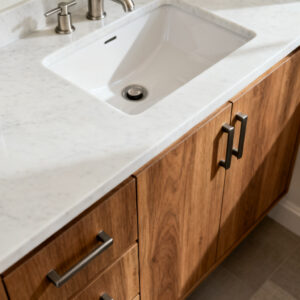
Shaker style remains the most versatile and consistently popular choice across San Antonio. The recessed panel door works in transitional, traditional, and even softly contemporary bathrooms. It pairs well with virtually any countertop material, from quartz to marble to solid surface, and is available at every price point from stock to custom. White and off-white shaker vanities continue to lead sales in San Antonio, followed closely by soft gray and warm greige tones.
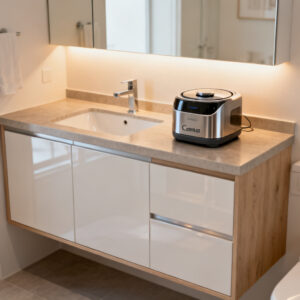
Flat panel or slab style is the go-to for homeowners who want a clean, contemporary look. There is no decorative routing, just smooth, flat door and drawer faces that reflect light evenly and make smaller bathrooms feel more open. High-gloss white and matte charcoal are particularly strong in this category in San Antonio’s 2026 market.
Raised panel remains a solid choice in San Antonio’s established neighborhoods where traditional architecture is the context. It has more visual detail than the shaker, which works well in bathrooms with classic tile and traditional fixtures. It tends to appear more in semi-custom and custom orders than in stock configurations.
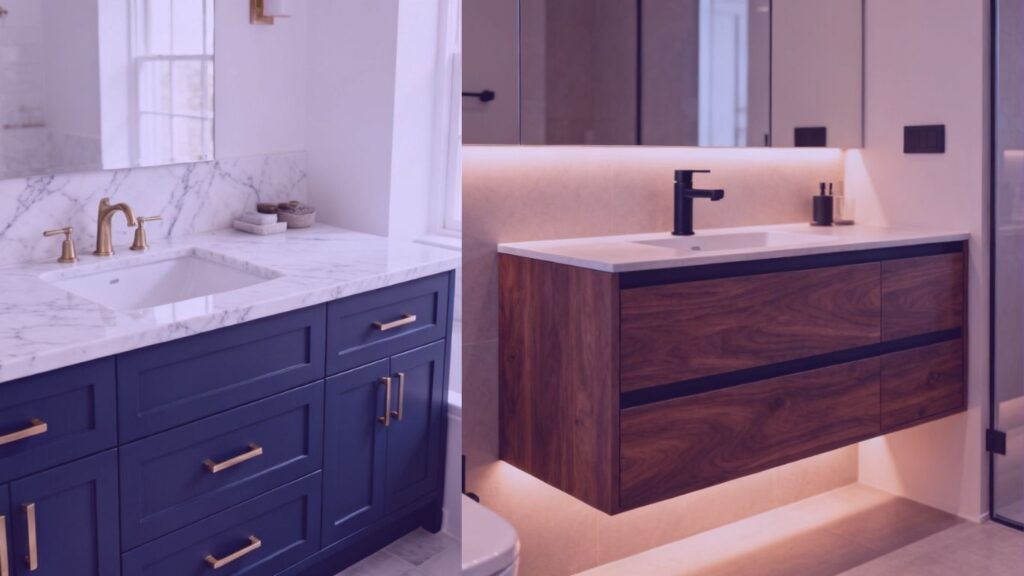
Two-tone vanities are gaining real traction in San Antonio primary bathrooms this year. The most common execution is a white or light upper cabinet paired with a deeper navy, forest green, or charcoal lower unit. This works particularly well in larger primary bathrooms where a single neutral finish across a long wall run can feel flat.
Floating or wall-mounted vanities are growing in popularity in San Antonio renovation projects, particularly in contemporary and transitional bathrooms. The open floor space beneath the cabinet makes the bathroom feel larger, and the clean horizontal lines suit modern design preferences. Installation requires solid wall blocking and professional fitting, which adds to the cost, but the visual result is consistently striking.
4. Bathroom Vanity Cabinet Sizes: What Fits and What Does Not:
Sizing is where the most avoidable mistakes happen when buying bathroom vanity cabinets in San Antonio. A cabinet that is the wrong size by even a few inches creates problems that range from cosmetic to structural.
Here are the measurements to confirm before ordering anything.
Width is the most obvious dimension and the most measured, but it needs to account for more than just available wall space. Subtract at least 2 to 3 inches from the total wall run to allow comfortable use and to accommodate any baseboard profile, adjacent door swing, or fixture clearance.
Depth is frequently underestimated. Standard bathroom vanity cabinets are 21 inches deep. Some narrow-profile options are available at 18 inches for tight conditions. Measure from the wall to the front edge of the toilet, any adjacent door, or any other obstruction to confirm depth clearance before selecting a standard or deep unit.
Height affects both comfort and countertop planning. Standard vanity height is 32 inches. Comfort height, which runs 34 to 36 inches, is increasingly preferred in San Antonio because it is easier on the back for taller adults and aligns more naturally with kitchen counter height for a cohesive feel in open floor plans. Confirm what height works with your countertop thickness, particularly if you are keeping an existing countertop or selecting a thick material like butcher block or thick-cut quartz.
Plumbing rough-in position is the measurement that gets skipped most often and causes the most problems. The drain center and supply lines in your wall need to land inside the open cabinet space of the new vanity. If they do not, the plumbing requires modification or the cabinet interior needs to be customized. When you order a custom vanity from Cabinet Bazaar in San Antonio, the plumbing position is confirmed during the pre-installation location visit, so the cabinet is built around your actual conditions.
5. Bathroom Vanity Cabinet Materials: What Holds Up in San Antonio’s Climate:
San Antonio’s climate creates real challenges for bathroom furniture that homeowners in drier regions do not face to the same degree. Humidity fluctuations, heat, and the constant presence of moisture from daily use mean that material choice directly affects how long your vanity cabinet lasts.
Plywood core is the most durable choice for the cabinet box. Plywood resists swelling, holds screws securely over years of use, and maintains its structural integrity even when humidity rises and falls seasonally. For the San Antonio market specifically, plywood box construction is the standard Cabinet Bazaar recommends for any vanity installation.
MDF core is denser and flatter than plywood, which makes it an excellent substrate for painted door and drawer faces. It takes paint smoothly without telegraphing grain, which is why many high-quality painted vanity doors are MDF-faced. The limitation is moisture sensitivity. Raw or compromised MDF absorbs water quickly and swells permanently, which is why it should be used for faces and doors rather than the cabinet box itself, particularly in the under-sink area where a minor plumbing leak can cause significant damage if the box is not water-resistant.
Particleboard core is the least expensive and least durable option. It is common in entry-level stock vanities and shows its limitations first at the cabinet floor, where any water exposure causes irreversible swelling and structural failure. For San Antonio bathrooms, particleboard core vanities should be avoided wherever possible, especially for primary bathrooms expected to last more than five to seven years.
Solid wood is used most effectively for face frames, door fronts, and drawer faces in higher-end custom vanities. It is rarely used for the full cabinet box because of cost and weight, but solid wood faces with a plywood box is the combination that delivers both visual quality and structural performance.
For San Antonio homeowners, the practical minimum for a primary bathroom vanity is a plywood box with either plywood or MDF door fronts finished with a moisture-resistant topcoat.
-
How Much Do Bathroom Vanity Cabinets Cost in San Antonio?
Here is a clear cost breakdown for San Antonio in 2026. These are cabinet-only figures and do not include countertops, sinks, faucets, or installation labor.
| Vanity Type | Width Range | Estimated Cabinet Cost |
| Stock, basic construction | 24 to 36 inches | $150 to $400 |
| Stock, mid-range construction | 48 to 60 inches | $400 to $800 |
| Semi-custom single vanity | 30 to 60 inches | $600 to $1,800 |
| Semi-custom double vanity | 60 to 72 inches | $1,000 to $2,500 |
| Custom single vanity | Any width | $800 to $2,800 |
| Custom double vanity | 60 to 84 inches | $1,500 to $5,000+ |
Installation labor for a standard vanity replacement in San Antonio runs $200 to $600 for a single unit. Double vanity installations, or any project involving plumbing relocation, will add to that range. Countertops for a 36-inch vanity typically cost $300 to $900 in San Antonio, depending on material, edge profile, and cutout requirements.
The total cost of a complete single vanity replacement in San Antonio, including cabinet, countertop, and installation, runs approximately $900 to $3,500 for mid-range semi-custom. A complete double vanity replacement in the same tier runs $2,000 to $6,000.
-
Affordable Bathroom Cabinets in San Antonio: What to Expect at Every Price Point:
Affordable means different things to different people, so it is more useful to be specific about what each price tier actually delivers for San Antonio homeowners in 2026.
Under $500 (cabinet only) covers stock vanities in standard sizes, typically with MDF or particleboard construction and a limited finish selection of two to four colors. The hardware is functional but basic, with standard hinges rather than soft-close. These are appropriate for guest bathrooms, rental properties, or secondary bathrooms where longevity is less of a priority than keeping the upfront cost low.
$500 to $1,500 is where the quality picture changes meaningfully. At this level, plywood box construction becomes more consistent, soft-close hinges and drawer glides are standard, and the finish palette widens to include custom paint colors and a broader selection of stains. Interior configuration options such as pull-out organizers, adjustable shelving, and drawer banks instead of door-only interiors are available in this tier. For a primary bathroom in a San Antonio home, this range delivers the best balance of durability, function, and cost.
$1,500 and above is the beginning of custom territory, where size flexibility is complete, material standards are highest, and the interior is configured specifically for your bathroom and storage habits. For homeowners investing in a full bathroom renovation and expecting the vanity to remain in place for fifteen or more years, this level of investment makes strong financial sense.
Regardless of budget, the single most important quality indicator is box construction. A plywood box with a simple shaker door will outperform a particleboard box with an elaborate decorative door in every practical measure over time.
-
Custom vs. Stock Bathroom Vanity Cabinets: Which Is the Better Investment?
The honest answer is that it depends on your specific bathroom and how long you plan to stay in the home.
Stock vanities work well when your bathroom has standard dimensions, your plumbing rough-in is conventionally positioned, and you are working with a straightforward layout. They are available quickly, cost less upfront, and, for standard conditions, they can look and function just as well as a semi-custom option. The trade-off is limited size flexibility and a narrower finish range.
Custom vanities make more sense when your bathroom has non-standard dimensions, when you want a specific finish or interior configuration that stock lines do not carry, or when you are doing a full renovation and want every element of the bathroom to work together visually and functionally. Custom also makes sense in San Antonio’s older homes, where bathrooms frequently have unusual dimensions, plumbing in unconventional positions, or wall conditions that make standard-size units impractical without significant compromise.
One point worth knowing: the price gap between a well-specified semi-custom and an entry-level custom vanity is often smaller than homeowners expect. In San Antonio’s cabinet market, a custom single vanity from Cabinet Bazaar starts at a price point that surprises many first-time custom buyers. Getting a quote before assuming custom is out of reach is always worth doing.
-
Where to Buy Bathroom Vanity Cabinets in San Antonio
San Antonio homeowners have several options, each with real trade-offs.
Big-box retailers carry a broad stock selection at accessible price points. They are convenient for straightforward replacements when a standard size fits, and no customization is needed. The limitations are in-store expertise, limited finish options, and no integration with installation services.
Online retailers offer competitive pricing and a large catalog, but require you to confirm your own measurements, manage freight delivery logistics, and arrange installation separately. Transit damage is a real and common risk with cabinet orders. Returns are complicated and costly when a unit does not fit or arrives with damage.
Local cabinet showrooms in San Antonio give you the ability to see and feel products in person, access genuine expertise from people who know the local market, and work with a single point of contact from selection through installation. For any primary bathroom renovation, a showroom visit produces a better outcome than buying remotely, because the decisions involved, size, finish, material, and interior configuration, benefit directly from in-person guidance.